Park Factors

Last Updated: 1:30 AM
The weather is cooling down for most venues on Tuesday with temps in the 60s and 70s for 10 of 12 outdoor games. The clear top venue for offense is Sutter Health Park where it will be 88° at start time with 10-15 mph wind blowing out. This set of conditions are the norm in Sacramento during the summer where the minor league stadium has become MLB's most favorable park for homers, mostly due to how receptive it is to out-blowing wind.
The next best venue for home runs on Tuesday is Yankee Stadium where it will be in the mid 70s with moderate wind blowing out toward the short porch in right. Dodger Stadium will have similar conditions, although not particularly notable as the out-blowing wind pattern is extremely consistent in L.A.
The hotter-than-normal Seattle weather continues to elevate T-Mobile Park's run environment. Temperatures will be in the 80s once again, earning what's often a pitcher-friendly spot a more neutral rating for Padres / Mariners.
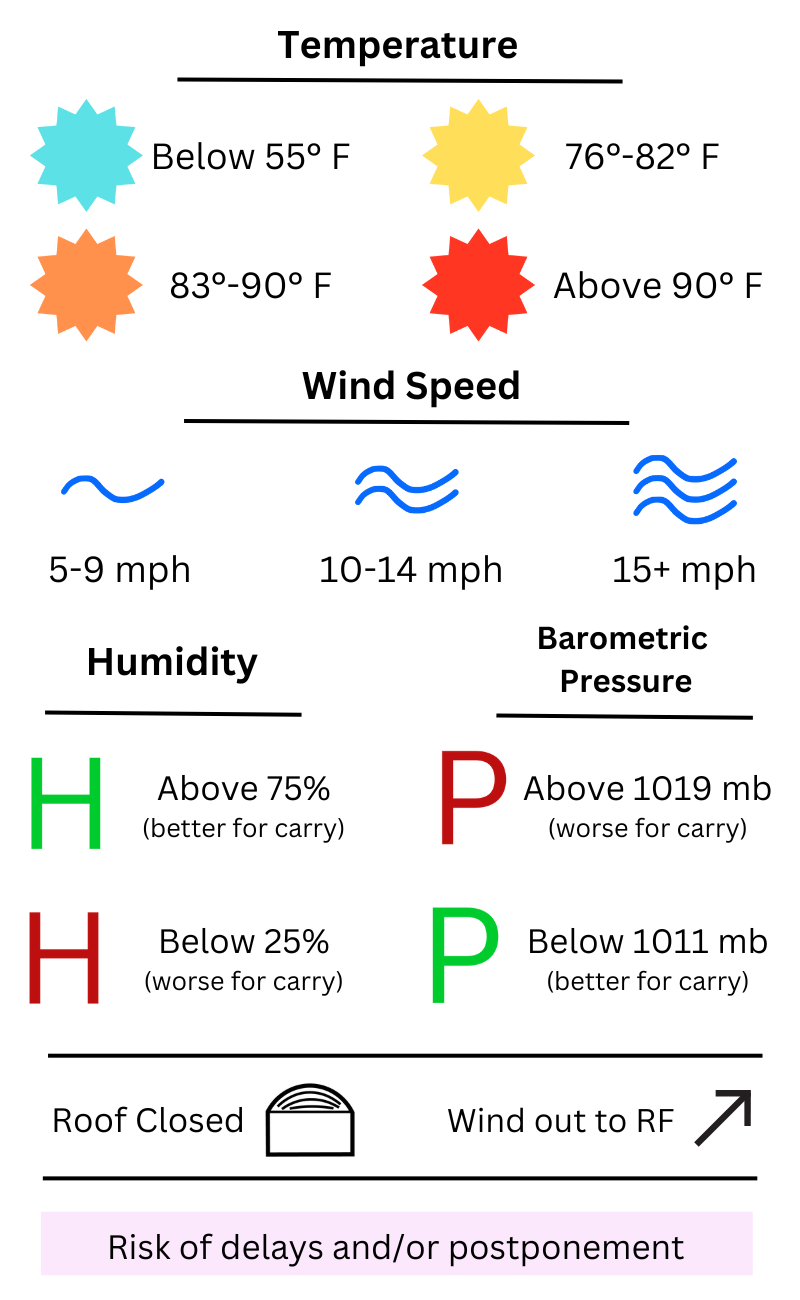
High air pressure is a factor for the Midwest venues on Tuesday's slate (as indicated by the red "P"s in the chart below). Like lower temperatures, higher pressure is worse for offense as it reduces how far the ball flies.
Oracle Park is back on the slate with its typical out-blowing wind forecast. As mentioned here throughout the season, this isn't notable as the forecast isn't indicative of how the wind behaves inside the stadium. Like previous seasons, Oracle has ranked at the bottom of the league in homers this year despite the "always out" forecast for every Giants home game.
| Game | HR | 2B/3B | 1B | Runs | Receptive | Hour 1 | Hour 2 | Hour 3 | Hour 1 | Hour 2 | Hour 3 | Humidity | Pressure | Outfield Size |
Altitude | Typical Flight |
Contact Rate |
Contact Quality |
Description | HR | 2B/3B | 1B | Runs | |||||
|---|---|---|---|---|---|---|---|---|---|---|---|---|---|---|---|---|---|---|---|---|---|---|---|---|---|---|---|---|
Sutter Health Park 10:05 | +34% | +7% | +7% | +21% | Very High | 13  | 12  | 9 | 79° | 75° | 72° | 41% | 1011 | Large | 30 | Good | Avg | The temporary home of the Athletics. Features a spacious outfield with a tiny right-field fence. Standard to the corners and center, bowed outward in the gaps. | +0.76 | +0.25 | +0.72 | +1.87 | ||||||
Oriole Park 6:35 | -2% | -1% | +11% | +8% | Med-High | 4  | 2  | 4  | 77° | 75° | 73° | 41% | 1017 | Variable | 130 | -1 | Great | Good | A uniquely-shaped field with a home-run-friendly right side. The left-field corner is particularly deep while most of the outfield perimeter is closer than average. A 21-foot-tall fence compensates for the short distance down the right field line. | -0.04 | -0.03 | +1.14 | +0.69 | |||||
Dodger Stadium 10:10 | +13% | -6% | -1% | +2% | Consistent | 7  | 6 | 5 | 79° | 75° | 73° | 63% | 1014 | Medium | 267 | +3 | Avg | Great | A symmetrical outfield with a highly consistent wind pattern (out to right-center). Plays deep down the lines and particularly shallow to center field. | +0.29 | -0.21 | -0.13 | +0.15 | |||||
T-Mobile Park 9:40 | +5% | -7% | -2% | -2% | Medium | 4 | 2 | 4 | 86° | 82° | 81° | 39% | 1011 | Small | 10 | -6 | Poor | Bad | One of the smallest outfields in MLB, justified by cooler weather and short carry distances. Strikeouts are boosted by low altitude and a tricky batters eye. | +0.10 | -0.24 | -0.24 | -0.15 | |||||
Oracle Park 9:45 | -24% | +3% | +10% | -2% | Consistent | 12 | 12 | 11 | 61° | 59° | 59° | 90% | 1014 | Variable | 63 | 0 | Good | Poor | A uniquely shaped field with a 24 foot-tall fence guarding a very shallow right-field corner. Straight-away center is close to home plate but extends to an extremely deep right-field gap. Cool temperatures are the norm and the ever-present out-blowing wind is neutralized by the stadium architecture. | -0.55 | +0.09 | +1.02 | -0.15 | |||||
Rogers Centre 7:07 | +0% | +1% | -3% | -2% | Minimal | 7  | 7  | 6 | 64° | 63° | 63° | 61% | 1018 | Medium | 247 | +0 | Great | Good | A neutral-sized retractable roof venue where every opportunity is taken to play outdoors. A closed roof is well-received by hitters on cold Toronto days but can favor pitchers when its hot out. | +0.00 | +0.02 | -0.34 | -0.19 | |||||
Rate Field 7:40 | +8% | -21% | +4% | -3% | Med-High | 8 | 7 | 6 | 70° | 70° | 68° | 44% | 1022 | Small | 596 | -3 | Bad | Avg | The smallest outfield in MLB. Shallow in every direction. Not nearly as wind-prone as its Wrigley neighbor, but can be susceptible to homers - especially on hot days. | +0.18 | -0.73 | +0.41 | -0.25 | |||||
Yankee Stadium 7:05 | +18% | -20% | -4% | -4% | High | 11 | 9 | 6 | 77° | 75° | 73° | 44% | 1016 | Variable | 54 | -6 | Avg | Great | A rounded asymmetrical outfield with a very shallow right field wall. The short porch is balanced out by a larger-than-average left field, though still very short to the foul pole on that side. | +0.40 | -0.69 | -0.44 | -0.32 | |||||
LoanDepot Park 6:40 | -11% | +5% | -2% | -4% | Roof Closed | Roof Closed | Large | 15 | +0 | Good | Avg | A retractable-roof field that is normally enclosed. The tall fences and large outfield promote doubles while suppressing home runs. | -0.26 | +0.16 | -0.21 | -0.36 | ||||||||||||
Progressive Field 6:40 | -12% | -7% | +2% | -6% | High | 6 | 6 | 6 | 64° | 64° | 64° | 56% | 1021 | Small | 582 | -5 | Avg | Poor | A small outfield with two distinct halves. A 19-foot fence guards most of the outfield's left side while the shorter right-field fence leaves that half vulnerable to home runs. | -0.28 | -0.25 | +0.22 | -0.56 | |||||
Globe Life Field 8:05 | -3% | -9% | -3% | -7% | Roof Closed | Roof Closed | Medium | 616 | +8 | Avg | Great | A retractable roof venue with a zig-zag outfield. The left side is particularly deep while the right is better primed for homers. | -0.06 | -0.33 | -0.31 | -0.60 | ||||||||||||
Daikin Park 8:10 | 0% | -8% | -5% | -8% | Roof Closed | Roof Closed | Variable | 38 | 0 | Bad | Poor | A retractable-roof venue with strict rules for allowing an open roof. A one-of-a-kind shape with a particularly shallow left-field fence. Plays deep to center and short to right. | 0.00 | -0.29 | -0.57 | -0.70 | ||||||||||||
Busch Stadium 7:45 | -17% | -9% | +3% | -8% | Med-High | 8 | 6  | 6  | 79° | 75° | 73° | 42% | 1023 | Large | 455 | +3 | Good | Avg | A large, symmetrical outfield with deep corners and gaps. The center field fence is a few feet closer than the MLB standard. | -0.38 | -0.32 | +0.30 | -0.71 | |||||
American Family Fld 7:40 | +13% | -9% | -17% | -12% | Low | 7  | 7 | 7 | 68° | 66° | 64° | 46% | 1022 | Medium | 593 | +3 | Poor | Good | A retractable-roof venue with a zig-zag outfield. Deep to each side but shallow in the gaps and to center field. The horizontal shape reduces the number of hits that fall into play. | +0.29 | -0.32 | -1.79 | -1.02 | |||||
Citi Field 7:10 | -1% | -25% | -6% | -14% | Low | 10 | 9 | 6 | 77° | 75° | 73° | 43% | 1015 | Medium | 54 | -1 | Poor | Poor | An unusually-shaped outfield with deep corners, shallow gaps, and a deep straight-away measurement to center. One of the worst venues for batter contact in the league. | -0.02 | -0.88 | -0.61 | -1.26 | |||||