Park Factors

Last Updated: 1:30 AM
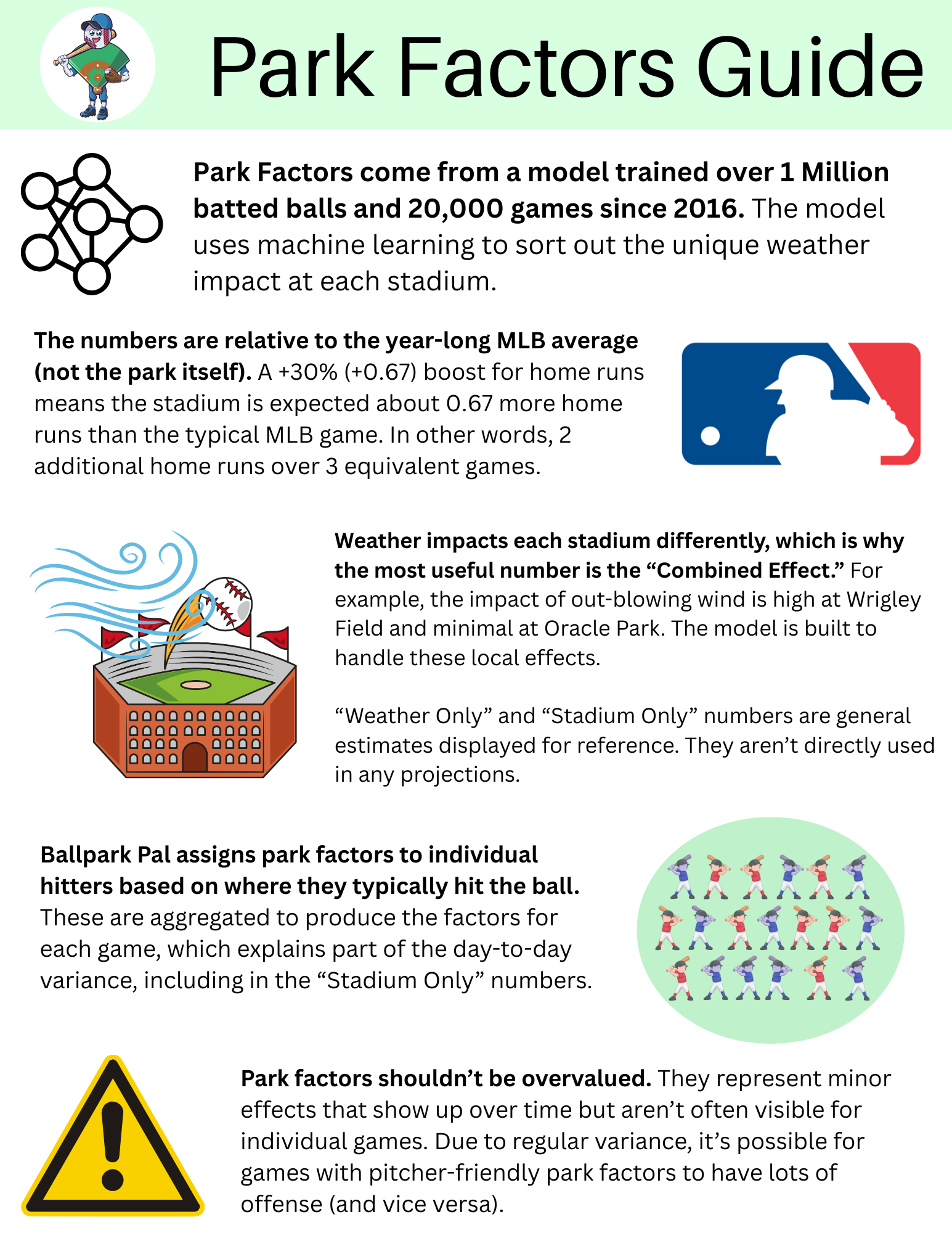
A wide variety of weather is set for Wednesday with temperatures ranging from upper 50s to mid 80s. The best hitting conditions on the slate are in Tampa where the 80° temps will be paired with light wind blowing out toward the short porch in right to start the game. Steinbrenner Field has been highly receptive to wind this year and the stadium/weather combo for Mariners / Rays on Wednesday is good for about 0.75 additional home runs on average (+33%).
Low air pressure is featured across much of Wednesday's slate which, like warm temperatures, is a factor that helps the ball fly farther. This is the case for a number Midwest venues today including Minnesota and Chicago where cooler temps in the 60s won't be as bad for offense as they normally might be.
The wind is blowing at double-digit speeds in Chicago on Wednesday, but the effect at Wrigley is considered neutral as it's expected to blow mostly left to right. Speed and direction is variable, however, so there's the chance a few fly balls might benefit from the wind (or vice versa). Wind of similar magnitude is expected in Detroit, but is angled in more toward hitters from right field.
A number of venues are flagged for possible delay/PPD due to rain on Wednesday with Athletics / Cardinals appearing the most at risk currently.
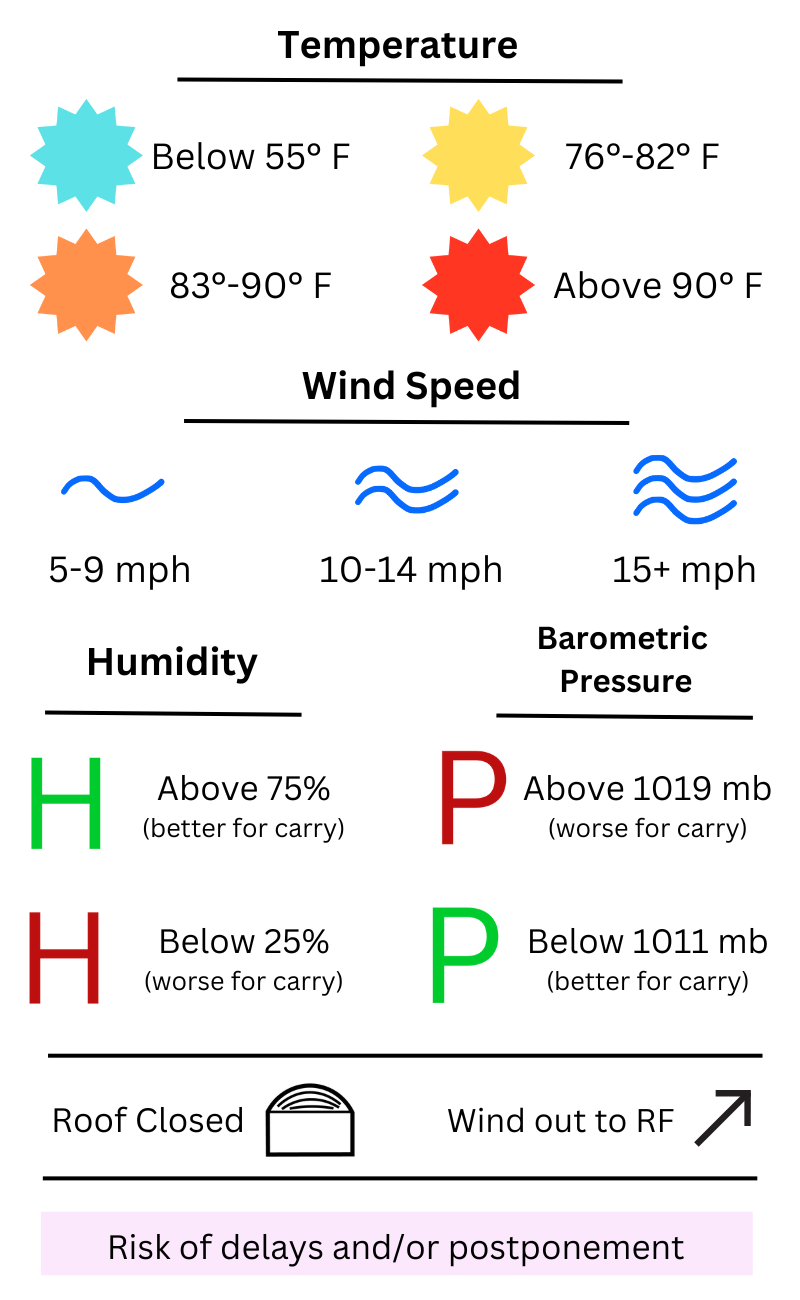
| Game | HR | 2B/3B | 1B | Runs | Receptive | Hour 1 | Hour 2 | Hour 3 | Hour 1 | Hour 2 | Hour 3 | Humidity | Pressure | Outfield Size |
Altitude | Typical Flight |
Contact Rate |
Contact Quality |
Description | HR | 2B/3B | 1B | Runs | |||||
|---|---|---|---|---|---|---|---|---|---|---|---|---|---|---|---|---|---|---|---|---|---|---|---|---|---|---|---|---|
Coors Field 8:40 | +22% | +34% | +14% | +35% | Low | 5  | 6  | 4  | 82° | 81° | 79° | 20% | 1012 | X-Large | 5,183 | +29 | Great | Avg | An extreme outlier of a stadium. Played 4,000 feet higher in altitude than the next closest MLB park. Has an extra-large outfield to accommodate much farther carry distances. Excellent for batter contact as the high altitude limits pitch effectiveness. | +0.49 | +1.20 | +1.52 | +3.09 | |||||
Fenway Park 6:45 | -4% | +27% | +10% | +17% | High | 10  | 7  | 7  | 72° | 70° | 68° | 53% | 1012 | Variable | 20 | -3 | Good | Great | A one-of-a-kind shape with a deep right field and a 37-foot-tall fence guarding the extremely shallow left side. Similarly, the 18-foot-tall fence in center offsets the close distance to home plate. While the tall fences help neutralize homers, they are excellent targets for singles and doubles. | -0.08 | +0.94 | +1.02 | +1.50 | |||||
Nationals Park 1:05 | +2% | +16% | +3% | +11% | Med-High | 2 | 2 | 3  | 79° | 81° | 82° | 40% | 1014 | Medium | 25 | -2 | Great | Great | A horizontal-shaped outfield with taller-than-average fences. Shallow to center field and deep to the corners. A 16-foot wall covers most of the right-field gap, compensating for how close it is at parts. | +0.06 | +0.57 | +0.35 | +0.94 | |||||
Chase Field 3:40 | -2% | +14% | +4% | +8% | Roof Closed | Roof Closed | Large | 1,082 | +11 | Great | Bad | The highest MLB altitude outside of Coors. Large outfield to accommodate longer carry distance on fly balls. Massive 25-foot center field fence. | -0.04 | +0.51 | +0.39 | +0.70 | ||||||||||||
Kauffman Stadium 7:40 | -14% | +15% | +9% | +8% | High | 8  | 12  | 10 | 73° | 72° | 70° | 79% | 1010 | X-Large | 750 | +5 | Great | Good | The largest non-Coors outfield in MLB. Perfectly symmetrical with a 9-foot-tall fence rounding the perimeter. | -0.31 | +0.53 | +0.91 | +0.66 | |||||
Great American BP 6:40 | +11% | -3% | +4% | +7% | Low | 7 | 6 | 5 | 82° | 79° | 77° | 42% | 1009 | Small | 683 | +0 | Bad | Avg | The smallest outfield in MLB, offset partially by a taller left-field wall. Stadium architecture dampens the effect from wind but hot days can turn GABP into a home run paradise. | +0.26 | -0.10 | +0.48 | +0.63 | |||||
Steinbrenner Field 7:35 | +28% | -8% | -2% | +6% | Very High | 6  | 3 | 2  | 86° | 84° | 84° | 64% | 1010 | Variable | 48 | Poor | ? | The temporary home of the Rays. Features the exact same dimensions as Yankee Stadium. Very short to right and deeper-than-average to most of left field. Should usually be hitter-friendly, especially during the summer. At risk for lots of rainouts. | +0.63 | -0.27 | -0.24 | +0.52 | ||||||
PNC Park 6:40 | -8% | +14% | 0% | +3% | Med-High | 8 | 9 | 7 | 81° | 79° | 77° | 39% | 1009 | Variable | 743 | +5 | Good | Bad | An asymmetrical venue with an extremely deep left field fence. Tall fences guard against an otherwise shallow outfield. The 21-foot-tall fence down the right field line makes a good target for extra base hits in the yard. | -0.17 | +0.48 | -0.01 | +0.27 | |||||
Busch Stadium 7:45 | +4% | -15% | +6% | 0% | Med-High | 7 | 5 | 11 | 84° | 82° | 79° | 44% | 1008 | Large | 455 | +3 | Good | Avg | A large, symmetrical outfield with deep corners and gaps. The center field fence is a few feet closer than the MLB standard. | +0.08 | -0.54 | +0.66 | -0.01 | |||||
Wrigley Field 7:40 | +0% | -4% | +0% | -2% | Extreme | 12 | 12 | 13 | 70° | 68° | 68° | 75% | 1006 | Medium | 596 | -2 | Poor | Bad | The most wind-receptive venue in baseball (by a lot). Out-blowing wind tends to correlate with warmer temperatures, and vice versa. The Corners are very deep and guarded by 16-foot-tall-fences. An extremely shallow porch in left-center makes for a cheap home run target. | +0.01 | -0.16 | +0.04 | -0.15 | |||||
Petco Park 4:10 | +5% | -12% | -2% | -4% | Low | 9 | 11 | 11 | 82° | 82° | 82° | 61% | 1013 | Medium | 13 | -2 | Avg | Avg | A medium-sized outfield with consistent weather conditions. Plays shallow to center and deeper to both sides. The San Diego marine layer can reduce carry distance, especially at night. | +0.12 | -0.42 | -0.18 | -0.36 | |||||
Comerica Park 1:10 | -17% | -8% | +9% | -5% | High | 13  | 14 | 14 | 79° | 81° | 81° | 40% | 1008 | Large | 596 | -3 | Avg | Avg | A challenging venue for home runs with a very deep center field. The entire left side is deeper than average and the 15-foot-tall fence in right further complicates things for hitters. Batter contact is better than most parks, possibly aided by a clean batter's eye. | -0.39 | -0.28 | +0.93 | -0.41 | |||||
American Family Fld 7:40 | +6% | -7% | -9% | -8% | Roof Closed | Roof Closed | Medium | 593 | +3 | Poor | Good | A retractable-roof venue with a zig-zag outfield. Deep to each side but shallow in the gaps and to center field. The horizontal shape reduces the number of hits that fall into play. | +0.13 | -0.24 | -0.98 | -0.67 | ||||||||||||
Daikin Park 8:10 | -3% | -7% | -5% | -8% | Roof Closed | Roof Closed | Variable | 38 | 0 | Bad | Poor | A retractable-roof venue with strict rules for allowing an open roof. A one-of-a-kind shape with a particularly shallow left-field fence. Plays deep to center and short to right. | -0.07 | -0.26 | -0.53 | -0.74 | ||||||||||||
Target Field 7:40 | -13% | -6% | -5% | -12% | Medium | 9  | 6  | 7 | 63° | 61° | 59° | 46% | 1011 | Medium | 812 | +0 | Avg | Good | A slightly asymmetric outfield with a deeper-than-average left side. The more shallow right side is guarded by a 23-foot-tall fence with a unique balcony overhanging the field. | -0.29 | -0.23 | -0.53 | -1.04 | |||||