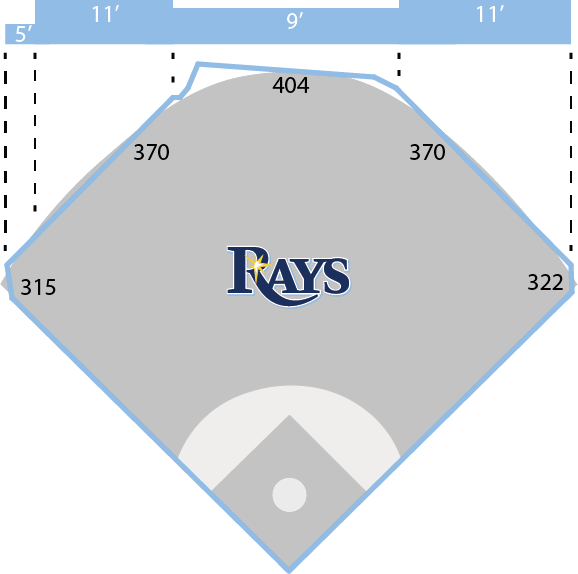
Florida Sun Coast Dome (as it was originally known) was built with the intention of luring an existing MLB team to Tampa. The plan didn't come through until later in the decade when the city finally hosted the expansion Devil Rays (though it did land the NHL's Lightning a few years earlier).
Tropicana Field is often known as one of the worst venues in the league, but it's undoubtedly a unique place for a baseball game. Hanging above the field are a series of circular catwalks that are very much in reach of fly balls, and the ground rules around those structures can turn an ordinary pop-up into a moment of real chaos. Tropicana Field is the only dome stadium in MLB without a retractable roof, and it consequently ranks 30th in day-to-day park variation (the most consistent environment in the sport).
The original design at Tropicana Field called for a large symmetrical field, but by the time it finally acquired the Devil Rays, that type of cookie-cutter stadium had fallen out of style. As a result, the field was altered to a more distinctive shape. The park plays relatively short to both foul poles, but the corners quickly stretch away from home plate, which can make the apparent dimensions a bit misleading. The most inviting home run target is down the left-field line where the wall is unusually low, while center field - especially left-center - plays deeper in a way that's reminiscent of
Fenway Park's Triangle. Other than that short left-field corner, the fences are generally taller than average around the rest of the perimeter. Overall, Ballpark Pal rates Tropicana Field 19th for home runs, 26th for singles, and 19th for doubles and triples.
In October 2024, Hurricane Milton shredded the roof and forced the Rays to relocate for the entire 2025 season while the city replaced the roof and repaired the interior. The Rays are scheduled to return to Tropicana Field for the 2026 season, with a home opener on April 6 against the Cubs.