
Built in 1989, Skydome (as it was originally called) was the last multi-purpose stadium constructed in North America. In addition to the Blue Jays it has also hosted the Toronto Argonauts, Raptors, and Buffalo Bills. When it was built, Rogers Centre's retractable roof was considered state-of-the-art and quite the luxury in Toronto where snow and freezing temperatures are common during the early months of the season.
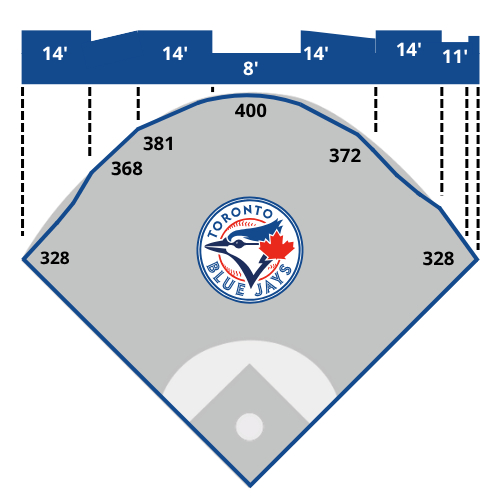
On the field, Rogers Centre no longer resembles the symmetrical, neutral-dimension stadium it once was. Prior to 2023 the outfield measured a uniform 328 down the lines, 375 to the gaps, and 400 to center with walls roughly 10 feet high throughout. That changed dramatically beginning in 2023 and continuing through 2024 when the Blue Jays unveiled a fully redesigned outfield wall structure. The new configuration introduced varied wall heights and asymmetrical distances, fundamentally altering both the look and the play of the park.
The left field line now plays slightly closer but with a wall rising to roughly 14 feet, while portions of left-center and right-center were brought in significantly and paired with taller fencing. The right-center wall in particular is both noticeably closer and substantially higher than before, creating a target that rewards true carry but punishes marginal fly balls. Meanwhile, center field remains 400 feet but with a reduced 8-foot wall. The result is a layered wall profile that produces more dynamic caroms and forces outfielders to defend vertically as much as laterally.
Statistically, the park now grades closer to neutral than in previous seasons. Rogers Centre ranks 12th in MLB for home runs, but only 18th for doubles and triples and 22nd for overall runs. While still slightly favorable for home run power (HomeRunOverall: +0.0197), overall run scoring has dipped below league average (RunsOverall: -0.034). The taller walls appear to have trimmed some of the cheap opposite-field home runs that previously defined the venue while introducing more nuanced batted-ball outcomes off the new surfaces.
One lingering advantage for pitchers remains the abundance of foul territory, a remnant of its multi-purpose design. It is not as extreme as Preview-Park-Summary.php?VenueId=10, but it still converts more pop-ups into outs than most modern baseball-specific parks.
Environmental conditions remain highly controlled. Wind averages 8.1 mph (18th in MLB), but Rogers Centre ranks 30th in overall wind receptiveness, meaning forecast wind rarely translates into meaningful carry differences on the field. Even when the roof is open, the towering seating decks and overhanging structure shield the playing surface from external airflow. The wind blows out 48% of the time compared to 32% blowing in, but its impact is minimal.
Temperature averages 73.4 degrees (19th in MLB), and with the roof closed 42% of games and open 58%, extreme cold is largely eliminated from the seasonal profile. Overall, Rogers Centre ranks 23rd in day-to-day variation, placing it in the lower-middle tier for environmental volatility.
The modern Rogers Centre is no longer a symmetrical dome with neutral dimensions. It is an asymmetrical, vertically contoured ballpark whose wall heights now play as large a role as its distances — a meaningful architectural shift that has subtly recalibrated its statistical identity.
On the field, Rogers Centre no longer resembles the symmetrical, neutral-dimension stadium it once was. Prior to 2023 the outfield measured a uniform 328 down the lines, 375 to the gaps, and 400 to center with walls roughly 10 feet high throughout. That changed dramatically beginning in 2023 and continuing through 2024 when the Blue Jays unveiled a fully redesigned outfield wall structure. The new configuration introduced varied wall heights and asymmetrical distances, fundamentally altering both the look and the play of the park.
The left field line now plays slightly closer but with a wall rising to roughly 14 feet, while portions of left-center and right-center were brought in significantly and paired with taller fencing. The right-center wall in particular is both noticeably closer and substantially higher than before, creating a target that rewards true carry but punishes marginal fly balls. Meanwhile, center field remains 400 feet but with a reduced 8-foot wall. The result is a layered wall profile that produces more dynamic caroms and forces outfielders to defend vertically as much as laterally.
Statistically, the park now grades closer to neutral than in previous seasons. Rogers Centre ranks 12th in MLB for home runs, but only 18th for doubles and triples and 22nd for overall runs. While still slightly favorable for home run power (HomeRunOverall: +0.0197), overall run scoring has dipped below league average (RunsOverall: -0.034). The taller walls appear to have trimmed some of the cheap opposite-field home runs that previously defined the venue while introducing more nuanced batted-ball outcomes off the new surfaces.
One lingering advantage for pitchers remains the abundance of foul territory, a remnant of its multi-purpose design. It is not as extreme as Preview-Park-Summary.php?VenueId=10, but it still converts more pop-ups into outs than most modern baseball-specific parks.
Environmental conditions remain highly controlled. Wind averages 8.1 mph (18th in MLB), but Rogers Centre ranks 30th in overall wind receptiveness, meaning forecast wind rarely translates into meaningful carry differences on the field. Even when the roof is open, the towering seating decks and overhanging structure shield the playing surface from external airflow. The wind blows out 48% of the time compared to 32% blowing in, but its impact is minimal.
Temperature averages 73.4 degrees (19th in MLB), and with the roof closed 42% of games and open 58%, extreme cold is largely eliminated from the seasonal profile. Overall, Rogers Centre ranks 23rd in day-to-day variation, placing it in the lower-middle tier for environmental volatility.
The modern Rogers Centre is no longer a symmetrical dome with neutral dimensions. It is an asymmetrical, vertically contoured ballpark whose wall heights now play as large a role as its distances — a meaningful architectural shift that has subtly recalibrated its statistical identity.