
Built in 1998 for the expansion Diamondbacks, Chase Field has a handful of unique aspects that make it unlike any other MLB venue. The most distinguishing feature is the Phoenix climate, which routinely eclipses 100 degrees from mid-May through the end of September. A retractable roof is a necessity in Arizona and it is closed 72% of the time. When the roof is left open, the average temperature is 88.5 degrees — the highest in MLB.
The heat combined with Phoenix's 1,082-foot elevation (2nd highest in MLB) gives fly balls a measurable boost in distance. Batted balls carry about 1% farther than league average, which ranks 2nd in MLB for typical carry. In 2018, Chase became the second MLB venue to store its baseballs in a humidor, helping moderate the distance gains created by the dry desert air.
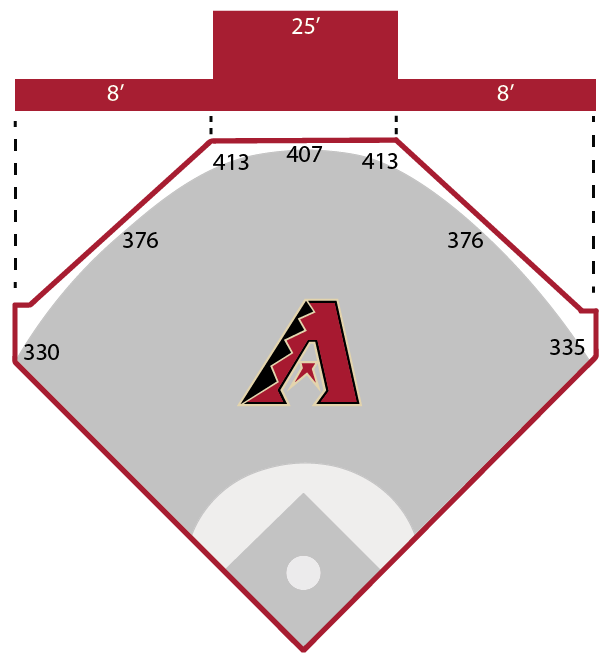
The stadium architects clearly anticipated the carry boost, as the outfield ranks 4th largest in MLB. The most distinguishing feature of the playing field is the wide, 25-foot-tall fence in center field, which turns plenty of deep fly balls into doubles and triples. That expansive layout helps explain why the park ranks 4th for doubles and triples, even though it sits just 25th for home runs.
Chase Field grades well for contact (ranked 6th), and overall offense checks in at 10th in MLB for runs. Despite the warm air and altitude, the combination of large dimensions and humidor usage prevents it from playing as an extreme home run venue like Coors Field.
Wind is typically modest in Phoenix (7.0 mph on average, 25th-highest in MLB), and the park ranks 22nd in wind receptiveness, meaning forecast wind is usually a secondary driver of carry compared to temperature, altitude, and roof status. Because the roof is closed most of the time, environmental conditions are relatively stable, and Chase Field ranks 27th in day-to-day park variation, placing it in the lower tier for volatility compared to fully outdoor stadiums.
The heat combined with Phoenix's 1,082-foot elevation (2nd highest in MLB) gives fly balls a measurable boost in distance. Batted balls carry about 1% farther than league average, which ranks 2nd in MLB for typical carry. In 2018, Chase became the second MLB venue to store its baseballs in a humidor, helping moderate the distance gains created by the dry desert air.
The stadium architects clearly anticipated the carry boost, as the outfield ranks 4th largest in MLB. The most distinguishing feature of the playing field is the wide, 25-foot-tall fence in center field, which turns plenty of deep fly balls into doubles and triples. That expansive layout helps explain why the park ranks 4th for doubles and triples, even though it sits just 25th for home runs.
Chase Field grades well for contact (ranked 6th), and overall offense checks in at 10th in MLB for runs. Despite the warm air and altitude, the combination of large dimensions and humidor usage prevents it from playing as an extreme home run venue like Coors Field.
Wind is typically modest in Phoenix (7.0 mph on average, 25th-highest in MLB), and the park ranks 22nd in wind receptiveness, meaning forecast wind is usually a secondary driver of carry compared to temperature, altitude, and roof status. Because the roof is closed most of the time, environmental conditions are relatively stable, and Chase Field ranks 27th in day-to-day park variation, placing it in the lower tier for volatility compared to fully outdoor stadiums.