Built originally for the Chicago Whales of the Federal League in 1914, Wrigley Field (then known as "Weeghman Park") did not begin to resemble its current-day form until 1938. That was the point at which the oddly off-center bleachers were added to the outfield, along with the taller-than-average brick walls covered with ivy. Wrigley Field is no doubt a classic one-of-a-kind stadium with a rich history rivaled only by Fenway Park among active venues. But as much as it is appreciated historically, Wrigley is just as interesting for how it influences the game on the field.
Perhaps its most notable in-play feature is how receptive it is to the strong winds that blow into and out of nearby Lake Michigan. Average wind speed is 9.7 mph (5th highest in MLB) and its effect on fly ball distance is unmatched across the league. Ballpark Pal ranks Wrigley Field 1st in overall wind receptiveness, including 1st for in-blowing wind impact and 2nd for out-blowing conditions.
Although wind direction is highly variable from day to day, it blows in 50% of games compared to 34% blowing out. Crosswinds occur less frequently, with winds blowing right-to-left 11% of the time and left-to-right just 5%.
Temperature also varies meaningfully throughout the season. The average game-time temperature is 69.9 degrees (27th warmest in MLB). Roughly 10% of games are played in the 40s, 11% in the 50s, 15% in the 60s, 42% in the 70s, 19% in the 80s, and 2% in the 90s. With both wind direction and temperature fluctuating substantially, Wrigley Field ranks 1st in MLB in overall park variation, and it is not particularly close.
While Wrigley's central tendency is to slightly suppress carry (-1.85%, ranked 26th), it can just as easily become one of the most hitter-friendly environments in baseball when conditions align.
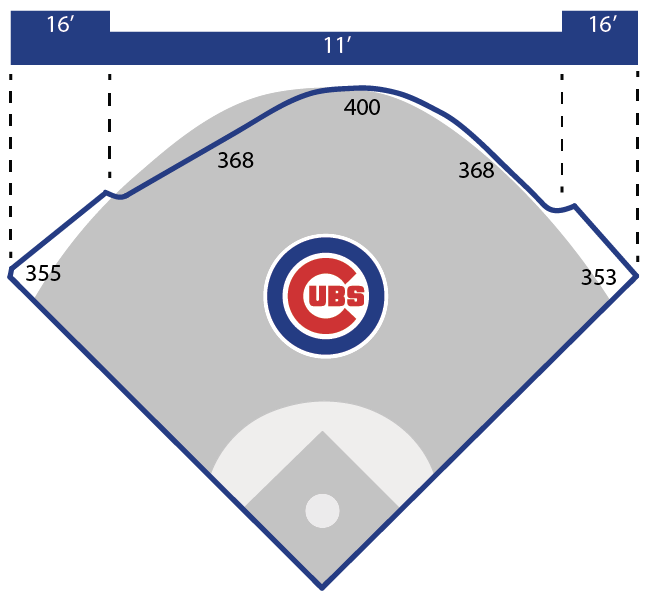
Also unmatched by any other venue is its peculiar shape. Wrigley has the deepest foul pole measurements in MLB (354 to left, 355 to right) and the corners of the field are guarded by 16-foot-tall walls on each side. As difficult as it is to hit a home run down the line, the types of fly balls that make it into the left field bleachers can sometimes be considered criminal. Although the fence is about three feet taller than average, the "368" sign in shallow left-center field marks one of the more favorable home run targets among active stadiums.
Perhaps its most notable in-play feature is how receptive it is to the strong winds that blow into and out of nearby Lake Michigan. Average wind speed is 9.7 mph (5th highest in MLB) and its effect on fly ball distance is unmatched across the league. Ballpark Pal ranks Wrigley Field 1st in overall wind receptiveness, including 1st for in-blowing wind impact and 2nd for out-blowing conditions.
Although wind direction is highly variable from day to day, it blows in 50% of games compared to 34% blowing out. Crosswinds occur less frequently, with winds blowing right-to-left 11% of the time and left-to-right just 5%.
Temperature also varies meaningfully throughout the season. The average game-time temperature is 69.9 degrees (27th warmest in MLB). Roughly 10% of games are played in the 40s, 11% in the 50s, 15% in the 60s, 42% in the 70s, 19% in the 80s, and 2% in the 90s. With both wind direction and temperature fluctuating substantially, Wrigley Field ranks 1st in MLB in overall park variation, and it is not particularly close.
While Wrigley's central tendency is to slightly suppress carry (-1.85%, ranked 26th), it can just as easily become one of the most hitter-friendly environments in baseball when conditions align.
Also unmatched by any other venue is its peculiar shape. Wrigley has the deepest foul pole measurements in MLB (354 to left, 355 to right) and the corners of the field are guarded by 16-foot-tall walls on each side. As difficult as it is to hit a home run down the line, the types of fly balls that make it into the left field bleachers can sometimes be considered criminal. Although the fence is about three feet taller than average, the "368" sign in shallow left-center field marks one of the more favorable home run targets among active stadiums.