
It's no secret that Coors Field is an outlier. Located in downtown Denver, the stadium sits 5,183 feet above sea level (highest in MLB) and roughly 4,000 feet above Chase Field (the next highest MLB venue). The thin air gives fly balls a distance boost, as Coors ranks 1st in MLB in carry distance (about +4% vs league average) — and that lead is massive, with the next-closest park (Chase Field) closer to about +1%.
But the altitude doesn't just change how far the ball travels — it changes how pitches behave. Coors Field ranks 1st in MLB in contact rate and 30th in strikeouts, a reflection of how much harder it is for pitchers to generate the same movement and swing-and-miss profile at elevation. More balls in play paired with boosted carry is a perfect recipe for consistent offense.
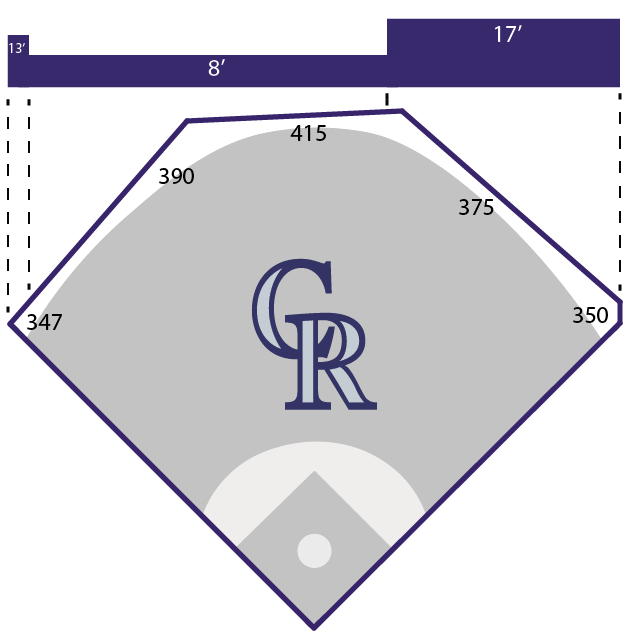
The outfield at Coors Field is oversized out of necessity. It measures 347 and 350 down the lines and stretches to 415 in straight-away center, with deep gaps that make it the largest outfield in MLB (ranked 1st in size). That extra space doesn't just absorb some would-be homers — it also creates runway for balls to land and roll, which helps explain why Coors is 1st in MLB for doubles and triples and 1st for extra-base hits overall.
In addition to its elevation, Coors Field plays in a dry climate, ranking 28th in humidity. To counteract the dry conditions, the Rockies were the first MLB team to introduce a humidor in 2003 to add moisture to baseballs and reduce their liveliness.
Put it all together and you get baseball's most extreme run environment. Overall, Ballpark Pal ranks Coors Field 1st in MLB for runs, 1st for doubles and triples, and 4th for home runs.
The temperature in Denver varies significantly throughout the season. Average game-time temperature is about 75 degrees, and 56% of games are played either below 60 degrees or above 80 degrees, making time of year a major factor in the day-to-day scoring environment. Despite its reputation for extreme offense, Coors Field is only moderately influenced by wind. Average wind speed is about 7.6 mph, and the venue ranks 15th in overall wind receptiveness. Overall, Coors Field ranks 8th in MLB for day-to-day park variation, driven more by temperature swings than wind.
But the altitude doesn't just change how far the ball travels — it changes how pitches behave. Coors Field ranks 1st in MLB in contact rate and 30th in strikeouts, a reflection of how much harder it is for pitchers to generate the same movement and swing-and-miss profile at elevation. More balls in play paired with boosted carry is a perfect recipe for consistent offense.
The outfield at Coors Field is oversized out of necessity. It measures 347 and 350 down the lines and stretches to 415 in straight-away center, with deep gaps that make it the largest outfield in MLB (ranked 1st in size). That extra space doesn't just absorb some would-be homers — it also creates runway for balls to land and roll, which helps explain why Coors is 1st in MLB for doubles and triples and 1st for extra-base hits overall.
In addition to its elevation, Coors Field plays in a dry climate, ranking 28th in humidity. To counteract the dry conditions, the Rockies were the first MLB team to introduce a humidor in 2003 to add moisture to baseballs and reduce their liveliness.
Put it all together and you get baseball's most extreme run environment. Overall, Ballpark Pal ranks Coors Field 1st in MLB for runs, 1st for doubles and triples, and 4th for home runs.
The temperature in Denver varies significantly throughout the season. Average game-time temperature is about 75 degrees, and 56% of games are played either below 60 degrees or above 80 degrees, making time of year a major factor in the day-to-day scoring environment. Despite its reputation for extreme offense, Coors Field is only moderately influenced by wind. Average wind speed is about 7.6 mph, and the venue ranks 15th in overall wind receptiveness. Overall, Coors Field ranks 8th in MLB for day-to-day park variation, driven more by temperature swings than wind.