
When ranking the best overall parks in MLB, Oriole Park at Camden Yards shows up near the top of most lists. Often praised for its aesthetics, fan experience, and seamless integration into Baltimore's Inner Harbor, the venue is widely considered the pioneer of the retro ballpark movement. After it hosted its first Orioles game in 1992, a wave of similarly designed parks followed. The most clearly influenced were Progressive Field, Citizens Bank Park, and PNC Park, each borrowing Camden Yards' asymmetry and open-air intimacy. Most importantly, its opening signaled the end of the multi-purpose, cookie-cutter stadium era.
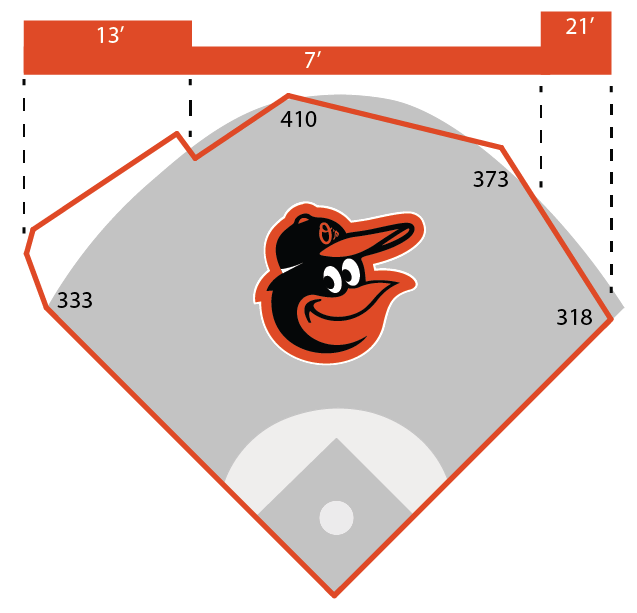
On the field, Camden Yards has undergone one of the most fascinating evolutions in modern ballpark design. For nearly three decades, it played as a welcoming home run venue, particularly to right-handed pull hitters targeting left field. That changed dramatically prior to the 2022 season when the Orioles raised the left-field wall from 7 to 13 feet and pushed it back as much as 26 feet in some areas. The move, quickly nicknamed 'Walltimore,' transformed left field into one of the most difficult home run spots in the majors.
However, after three seasons, the organization determined the change had overcorrected. Prior to the 2025 season, the Orioles adjusted again — bringing the left-field wall back in by up to roughly 20 feet in certain sections and lowering its height to approximately 8 feet. The result is a more balanced configuration. Left field is no longer the extreme suppressor it was from 2022–2024, but it still plays deeper than the pre-2022 version. Rather than fully reverting, Baltimore opted for a middle ground that restores some right-handed power potential while maintaining strategic depth in the gap.
The effect on run scoring is evident. Ballpark Pal now rates Camden Yards 5th in MLB for runs, 17th for home runs, and 7th for doubles and triples. Perhaps most notably, it ranks 2nd in MLB for singles, as the expanded and uniquely shaped outfield forces defenders to cover significant ground. Even with the left-field adjustments, the park has emerged as one of the league's most well-rounded offensive environments rather than a pure home-run haven.
Oriole Park's open-air design also leaves it moderately susceptible to weather. Wind in Baltimore averages 7 mph, but when it blows out, it matters. Camden Yards ranks 5th most receptive to out-blowing winds, while ranking 23rd for in-blowing wind receptiveness, suggesting the B&O warehouse in right, the large center-field scoreboard, and the tall three-deck grandstand in left help shield incoming gusts more than outgoing ones.
Temperature contributes further nuance. Start-time temperature averages 76 degrees (15th warmest in MLB), and Baltimore regularly experiences both cool spring nights and hot, humid summer evenings. That range contributes to Camden Yards ranking 6th in park variation, placing it firmly in the upper tier of environmental variability among outdoor venues.
Between its architectural legacy and its recent left-field redesign, Camden Yards remains both historically significant and strategically dynamic — a park that continues to evolve more than three decades after it reshaped modern ballpark design.
On the field, Camden Yards has undergone one of the most fascinating evolutions in modern ballpark design. For nearly three decades, it played as a welcoming home run venue, particularly to right-handed pull hitters targeting left field. That changed dramatically prior to the 2022 season when the Orioles raised the left-field wall from 7 to 13 feet and pushed it back as much as 26 feet in some areas. The move, quickly nicknamed 'Walltimore,' transformed left field into one of the most difficult home run spots in the majors.
However, after three seasons, the organization determined the change had overcorrected. Prior to the 2025 season, the Orioles adjusted again — bringing the left-field wall back in by up to roughly 20 feet in certain sections and lowering its height to approximately 8 feet. The result is a more balanced configuration. Left field is no longer the extreme suppressor it was from 2022–2024, but it still plays deeper than the pre-2022 version. Rather than fully reverting, Baltimore opted for a middle ground that restores some right-handed power potential while maintaining strategic depth in the gap.
The effect on run scoring is evident. Ballpark Pal now rates Camden Yards 5th in MLB for runs, 17th for home runs, and 7th for doubles and triples. Perhaps most notably, it ranks 2nd in MLB for singles, as the expanded and uniquely shaped outfield forces defenders to cover significant ground. Even with the left-field adjustments, the park has emerged as one of the league's most well-rounded offensive environments rather than a pure home-run haven.
Oriole Park's open-air design also leaves it moderately susceptible to weather. Wind in Baltimore averages 7 mph, but when it blows out, it matters. Camden Yards ranks 5th most receptive to out-blowing winds, while ranking 23rd for in-blowing wind receptiveness, suggesting the B&O warehouse in right, the large center-field scoreboard, and the tall three-deck grandstand in left help shield incoming gusts more than outgoing ones.
Temperature contributes further nuance. Start-time temperature averages 76 degrees (15th warmest in MLB), and Baltimore regularly experiences both cool spring nights and hot, humid summer evenings. That range contributes to Camden Yards ranking 6th in park variation, placing it firmly in the upper tier of environmental variability among outdoor venues.
Between its architectural legacy and its recent left-field redesign, Camden Yards remains both historically significant and strategically dynamic — a park that continues to evolve more than three decades after it reshaped modern ballpark design.