
Overlooking downtown Los Angeles, historic Dodger Stadium sits on a plateau next to the Chavez Ravine canyon. Built in 1962, it's the 3rd oldest venue in MLB that's still active and the field of play has actually changed very little over the previous 6 decades. The only modification was in 1969, when home plate was moved forward by about 10 feet to where it sits today.
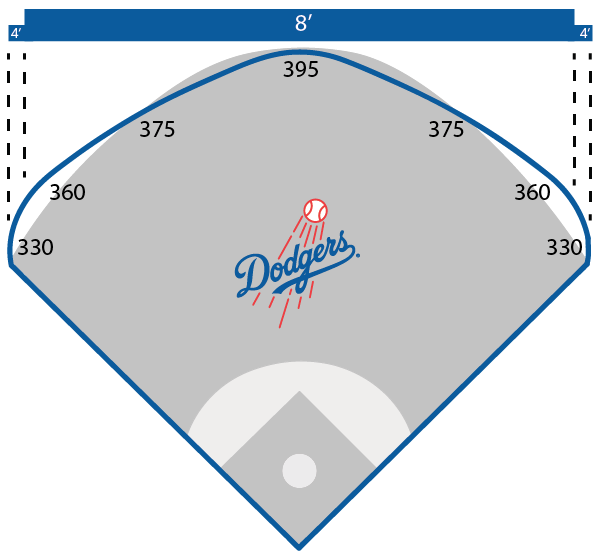
The center field fence at Dodger Stadium is particularly shallow, measuring just 395 feet away. That's the third shortest straight-away measurement in the league behind Fenway Park (390) and Oracle Park (391). The short distance to center helps make Dodger Stadium the 3rd most susceptible to home runs in all of MLB. While 80+ degree days are relatively limited, Los Angeles avoids the cold conditions that suppress carry in many other cities. The wind also plays a part toward its home run profile. Although wind speed is typically moderate (8.4 mph on average), it blows out 99% of the time. Nearly 50% of games feature winds blowing out toward center field, while crosswinds are rare, making straight-away fly balls particularly interesting on warmer nights.
Although center field is one of the more generous home run targets in MLB, the respective corners of the field actually play a fair bit deeper than the league average. Measurements down the lines are standard (330 feet), but the field is shaped so that it appears almost 'squished' from above, bulging out around the foul poles. The horizontal orientation of the field likely contributes to its moderate rate of doubles and triples (ranked 16th) as outfielders can cover most fly balls laterally rather than retreating deep toward the fence. One of the small quirks at Dodger Stadium is that it features MLB's shortest outfield fences (in height) down the lines, measuring just 4 feet tall for a stretch of about 50 feet on both sides.
The center field fence at Dodger Stadium is particularly shallow, measuring just 395 feet away. That's the third shortest straight-away measurement in the league behind Fenway Park (390) and Oracle Park (391). The short distance to center helps make Dodger Stadium the 3rd most susceptible to home runs in all of MLB. While 80+ degree days are relatively limited, Los Angeles avoids the cold conditions that suppress carry in many other cities. The wind also plays a part toward its home run profile. Although wind speed is typically moderate (8.4 mph on average), it blows out 99% of the time. Nearly 50% of games feature winds blowing out toward center field, while crosswinds are rare, making straight-away fly balls particularly interesting on warmer nights.
Although center field is one of the more generous home run targets in MLB, the respective corners of the field actually play a fair bit deeper than the league average. Measurements down the lines are standard (330 feet), but the field is shaped so that it appears almost 'squished' from above, bulging out around the foul poles. The horizontal orientation of the field likely contributes to its moderate rate of doubles and triples (ranked 16th) as outfielders can cover most fly balls laterally rather than retreating deep toward the fence. One of the small quirks at Dodger Stadium is that it features MLB's shortest outfield fences (in height) down the lines, measuring just 4 feet tall for a stretch of about 50 feet on both sides.