
The Giants played their home games at Candlestick Park from 1960-99. Throughout those four decades, 'The Stick' was infamous for its severe, swirling wind conditions. The strong gusts not only exacerbated the sub-60 degree nights that are so common in San Francisco, but it made fielding, hitting, and even pitching especially difficult. Perhaps the most famous on-field incident occurred during the 1961 All-Star game, in which Giants pitcher Stu Miller was blown off balance mid-pitch and was charged with a balk.
When the new Pacific Bell Park (as it was originally named) broke ground in 1997, controlling the wind inside the stadium was a top priority. A team of wind experts was commissioned to determine how best to minimize the impact of the strong gusts that are so familiar to the Bay Area. The consultants ended up doing a pretty good job as the wind is typically pretty calm inside of Oracle Park's confines relative to how it's blowing outside the stadium walls.
The forecasted wind direction is extremely consistent at Oracle Park. It's almost always expected to blow out to center, doing so 98% of the time, and average wind speed sits at 9.8 mph (4th highest in MLB). As a result, it's easy to misinterpret a given day's forecast as hitter-friendly. Make no mistake, Oracle Park is the 30th-ranked park for home runs, and the wind forecast is largely irrelevant to what occurs on the field. The venue ranks just 25th in overall wind receptiveness, meaning even strong forecasts rarely translate into meaningful carry gains. While the dominant wind direction in San Francisco suggests 'out to center,' the tall flags overlooking McCovey Cove can often be seen blowing back toward home plate. Additionally, many players have discussed in-blowing winds at Oracle despite the out-blowing forecast. This article from KNBR.com quotes both Evan Longoria and Mike Yastrzemski in mentioning winds blowing in from McCovey Cove during games.
It isn't just the wind that makes Oracle Park difficult for hitters. The Bay Area venue averages 66.4 degrees (29th in MLB), making it one of the coldest environments in the league. 22% of games are played in the 50s, with another 43% in the 60s. Night games are particularly chilly and it isn't uncommon for fans to bring gloves and heavy jackets to wear during the late innings, even in the summer. The cooler air contributes to a -2.3% typical carry adjustment (28th in MLB).
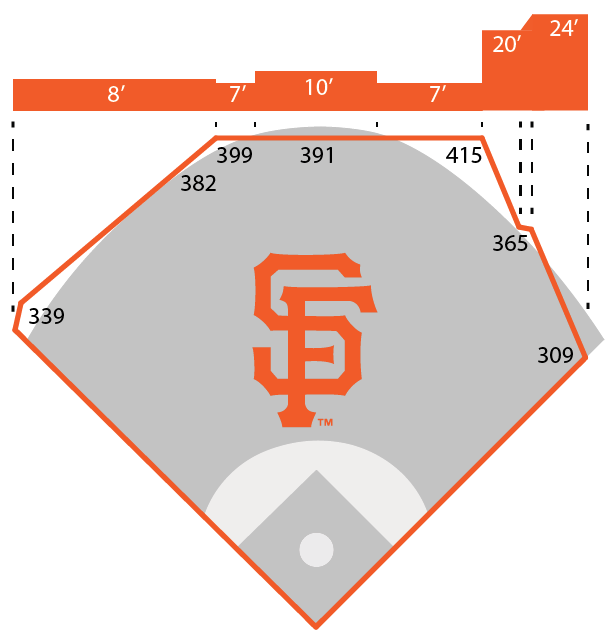
To pair with its unique climate is Oracle Park's equally distinctive shape. The right side of the field features a 25-foot brick wall which takes a nearly vertical line from the shallow '309' foul pole marker to the deep '415' sign in right-center. Although Barry Bonds made a habit of jacking moon-shots into McCovey Cove, Oracle's right side is no doubt one of MLB's most difficult home run spots. Dingers do not come easy to left either as every part of the fence out-measures the league average on that side. If there is one spot to homer at Oracle Park, it is straight-away center, which was brought in from 399 to 391 feet in 2020, making it MLB's second most shallow CF fence.
As much as it discourages home runs, Oracle is actually favorable for hits that stay in the yard. The 20-plus foot wall in right can turn would-be outs into doubles, and the deep corner in right-center, nicknamed 'Triples Alley,' often gives line drives in the gap the opportunity to roll for days. As it stands today, Triples Alley measures 415 feet from home plate, 6 feet closer than before the CF fence was moved in. Overall, Ballpark Pal ranks Oracle Park 4th for singles, 6th for doubles and triples, and 17th for total runs, reinforcing its identity as a park that suppresses homers but rewards balls kept in play.
When the new Pacific Bell Park (as it was originally named) broke ground in 1997, controlling the wind inside the stadium was a top priority. A team of wind experts was commissioned to determine how best to minimize the impact of the strong gusts that are so familiar to the Bay Area. The consultants ended up doing a pretty good job as the wind is typically pretty calm inside of Oracle Park's confines relative to how it's blowing outside the stadium walls.
The forecasted wind direction is extremely consistent at Oracle Park. It's almost always expected to blow out to center, doing so 98% of the time, and average wind speed sits at 9.8 mph (4th highest in MLB). As a result, it's easy to misinterpret a given day's forecast as hitter-friendly. Make no mistake, Oracle Park is the 30th-ranked park for home runs, and the wind forecast is largely irrelevant to what occurs on the field. The venue ranks just 25th in overall wind receptiveness, meaning even strong forecasts rarely translate into meaningful carry gains. While the dominant wind direction in San Francisco suggests 'out to center,' the tall flags overlooking McCovey Cove can often be seen blowing back toward home plate. Additionally, many players have discussed in-blowing winds at Oracle despite the out-blowing forecast. This article from KNBR.com quotes both Evan Longoria and Mike Yastrzemski in mentioning winds blowing in from McCovey Cove during games.
It isn't just the wind that makes Oracle Park difficult for hitters. The Bay Area venue averages 66.4 degrees (29th in MLB), making it one of the coldest environments in the league. 22% of games are played in the 50s, with another 43% in the 60s. Night games are particularly chilly and it isn't uncommon for fans to bring gloves and heavy jackets to wear during the late innings, even in the summer. The cooler air contributes to a -2.3% typical carry adjustment (28th in MLB).
To pair with its unique climate is Oracle Park's equally distinctive shape. The right side of the field features a 25-foot brick wall which takes a nearly vertical line from the shallow '309' foul pole marker to the deep '415' sign in right-center. Although Barry Bonds made a habit of jacking moon-shots into McCovey Cove, Oracle's right side is no doubt one of MLB's most difficult home run spots. Dingers do not come easy to left either as every part of the fence out-measures the league average on that side. If there is one spot to homer at Oracle Park, it is straight-away center, which was brought in from 399 to 391 feet in 2020, making it MLB's second most shallow CF fence.
As much as it discourages home runs, Oracle is actually favorable for hits that stay in the yard. The 20-plus foot wall in right can turn would-be outs into doubles, and the deep corner in right-center, nicknamed 'Triples Alley,' often gives line drives in the gap the opportunity to roll for days. As it stands today, Triples Alley measures 415 feet from home plate, 6 feet closer than before the CF fence was moved in. Overall, Ballpark Pal ranks Oracle Park 4th for singles, 6th for doubles and triples, and 17th for total runs, reinforcing its identity as a park that suppresses homers but rewards balls kept in play.