
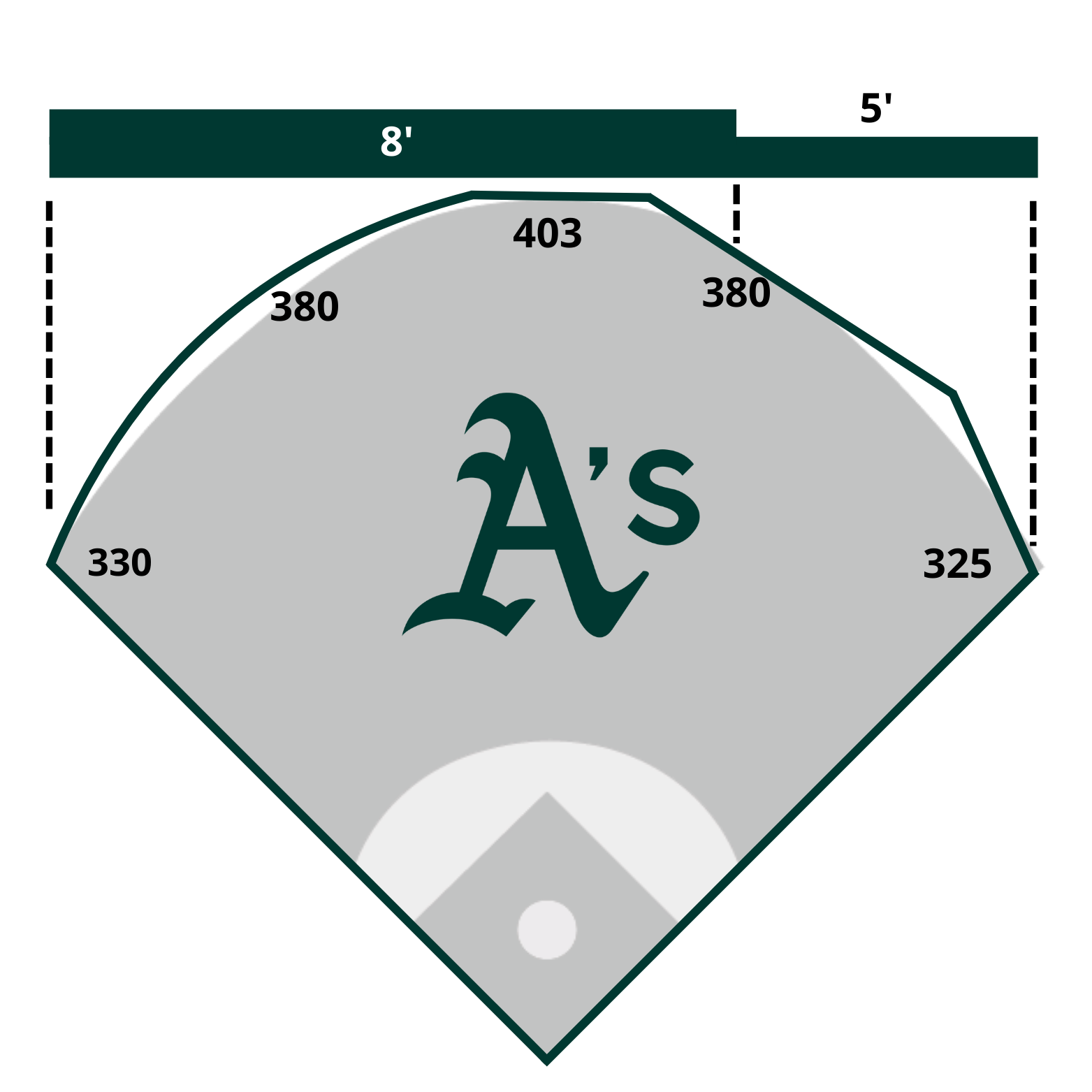
Sutter Health Park serves as the temporary home of the Athletics during their transition to Las Vegas, bringing Major League Baseball to Sacramento for the first time. Originally opened in 2000 as the home of the River Cats, the park now steps onto a much larger stage — and it immediately profiles as one of the most offense-enhancing environments in the league.
On the field, Sutter Health Park combines a 30th-ranked (largest) outfield footprint with conditions that dramatically reward well-struck fly balls. The spacious gaps promote extra-base damage, and that shows up in the data: the park ranks 3rd in MLB for doubles and triples and 4th for total hits. Balls that split the alleys have room to run, and the slightly bowed geometry of the outfield fence creates long pursuit angles for defenders.
What truly separates the venue, however, is its power environment. Sutter Health Park ranks 2nd in MLB for home runs and 2nd for total runs scored. While the physical dimensions are generous, the home run boost is driven largely by wind patterns and summer heat.
The wind in Sacramento is both frequent and directional. Average wind speed checks in at 11.1 mph (3rd highest in MLB), and it blows out an overwhelming 92% of the time, compared to just 1% blowing in. More specifically, winds blow out toward center field 55% of the time and toward left field 30%, creating a consistent jet stream effect that supports carry to the deepest parts of the yard. Even with only moderate receptiveness to outward wind (14th in out-blowing receptiveness; 8th overall wind receptiveness), the sheer consistency of outward flow makes it one of the league's most reliable power environments.
Temperature is another major factor. Average game-time temperature sits at 80.7 degrees (4th warmest in MLB), and the dry Northern California climate pairs with the heat to create lively hitting conditions throughout the summer. Despite a slightly below-average raw carry adjustment (-1.0% typical carry; 12th in MLB), the wind and warmth more than compensate, especially on balls hit to the middle third of the field.
At just 26 feet above sea level (21st in altitude), elevation does not meaningfully contribute to distance. Instead, Sutter Health Park's offensive profile is built on airflow patterns and seasonal warmth interacting with a large, gap-friendly outfield.
Unlike extreme weather parks such as Wrigley Field, Sacramento's environment is comparatively steady, ranking 14th in overall park variation. That means hitters can expect consistently favorable conditions rather than volatile day-to-day swings.
In short, Sutter Health Park plays big in terms of acreage but even bigger in terms of damage. The expansive alleys encourage extra-base hits, and the persistent outward wind — especially during the summer months — helps elevate it into one of baseball's most potent home run environments.
On the field, Sutter Health Park combines a 30th-ranked (largest) outfield footprint with conditions that dramatically reward well-struck fly balls. The spacious gaps promote extra-base damage, and that shows up in the data: the park ranks 3rd in MLB for doubles and triples and 4th for total hits. Balls that split the alleys have room to run, and the slightly bowed geometry of the outfield fence creates long pursuit angles for defenders.
What truly separates the venue, however, is its power environment. Sutter Health Park ranks 2nd in MLB for home runs and 2nd for total runs scored. While the physical dimensions are generous, the home run boost is driven largely by wind patterns and summer heat.
The wind in Sacramento is both frequent and directional. Average wind speed checks in at 11.1 mph (3rd highest in MLB), and it blows out an overwhelming 92% of the time, compared to just 1% blowing in. More specifically, winds blow out toward center field 55% of the time and toward left field 30%, creating a consistent jet stream effect that supports carry to the deepest parts of the yard. Even with only moderate receptiveness to outward wind (14th in out-blowing receptiveness; 8th overall wind receptiveness), the sheer consistency of outward flow makes it one of the league's most reliable power environments.
Temperature is another major factor. Average game-time temperature sits at 80.7 degrees (4th warmest in MLB), and the dry Northern California climate pairs with the heat to create lively hitting conditions throughout the summer. Despite a slightly below-average raw carry adjustment (-1.0% typical carry; 12th in MLB), the wind and warmth more than compensate, especially on balls hit to the middle third of the field.
At just 26 feet above sea level (21st in altitude), elevation does not meaningfully contribute to distance. Instead, Sutter Health Park's offensive profile is built on airflow patterns and seasonal warmth interacting with a large, gap-friendly outfield.
Unlike extreme weather parks such as Wrigley Field, Sacramento's environment is comparatively steady, ranking 14th in overall park variation. That means hitters can expect consistently favorable conditions rather than volatile day-to-day swings.
In short, Sutter Health Park plays big in terms of acreage but even bigger in terms of damage. The expansive alleys encourage extra-base hits, and the persistent outward wind — especially during the summer months — helps elevate it into one of baseball's most potent home run environments.