
Just a few years after Three Rivers Stadium was imploded at the other end of Pennsylvania, Philadelphia followed suit by demolishing an often detested stadium of their own. Not only was Veterans Stadium a bit mundane from a playing perspective, it had many physical issues including the seam-ridden AstroTurf and unstable support rails, the latter of which caused a serious accident in 1998 that led to calls for a new stadium. Needless to say, the introduction of the more modern Citizens Bank Park in 2004 was a breath of fresh air.
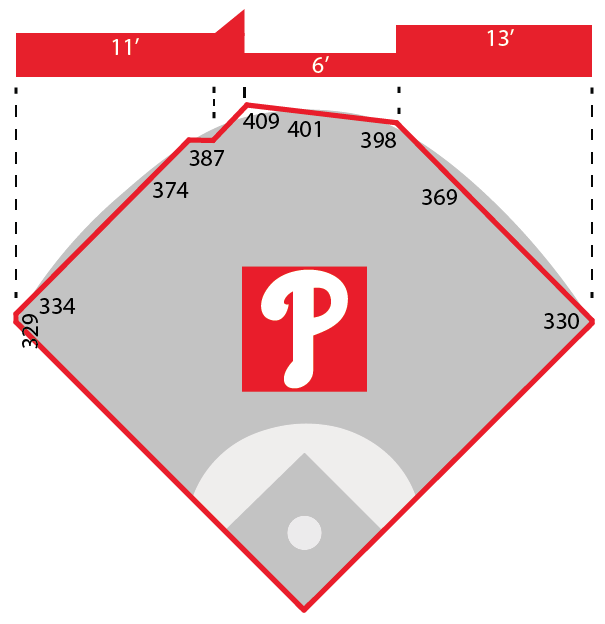
On the field, the newer South Philly venue can be considered one of MLB's top home run parks, ranking 5th in home run favorability and 9th in overall run environment. It also features the 29th-ranked outfield size (second smallest in MLB). The tight dimensions are partly offset by Philadelphia's low altitude (9 feet above sea level), and fly balls carry about 1% shorter than league average. Additionally, the taller-than-average fences in both left and right fields can sometimes turn would-be home runs into doubles. Even so, left and right are the best HR spots as CF actually plays a bit more difficult than neutral. Overall, the park ranks 17th for doubles and triples and 20th for singles.
Perhaps the most notable in-play feature of Citizens Bank is its receptiveness to wind. It ranks 4th overall in wind receptiveness, including 3rd for in-blowing wind impact and 12th for out-blowing impact. Average wind speed is 7.9 mph, with winds blowing out 47% of the time, in 22%, and sideways 30%. While wind speeds are typically moderate (19th in MLB), directional changes can meaningfully influence carry on a given day.
Temperature is another contributing factor. The average start-time temperature is 76.6 degrees (11th warmest in MLB), helping offset the slightly below-average baseline carry. Combined with its wind profile, Citizens Bank Park ranks 4th in MLB for day-to-day park variation, making it one of the more volatile outdoor hitting environments in the league.
On the field, the newer South Philly venue can be considered one of MLB's top home run parks, ranking 5th in home run favorability and 9th in overall run environment. It also features the 29th-ranked outfield size (second smallest in MLB). The tight dimensions are partly offset by Philadelphia's low altitude (9 feet above sea level), and fly balls carry about 1% shorter than league average. Additionally, the taller-than-average fences in both left and right fields can sometimes turn would-be home runs into doubles. Even so, left and right are the best HR spots as CF actually plays a bit more difficult than neutral. Overall, the park ranks 17th for doubles and triples and 20th for singles.
Perhaps the most notable in-play feature of Citizens Bank is its receptiveness to wind. It ranks 4th overall in wind receptiveness, including 3rd for in-blowing wind impact and 12th for out-blowing impact. Average wind speed is 7.9 mph, with winds blowing out 47% of the time, in 22%, and sideways 30%. While wind speeds are typically moderate (19th in MLB), directional changes can meaningfully influence carry on a given day.
Temperature is another contributing factor. The average start-time temperature is 76.6 degrees (11th warmest in MLB), helping offset the slightly below-average baseline carry. Combined with its wind profile, Citizens Bank Park ranks 4th in MLB for day-to-day park variation, making it one of the more volatile outdoor hitting environments in the league.