
Built in 1912, Fenway Park is the oldest active MLB stadium. It is perhaps the most famous venue in American sports (or at least in the top three) and it undoubtedly lives up to its expectations.
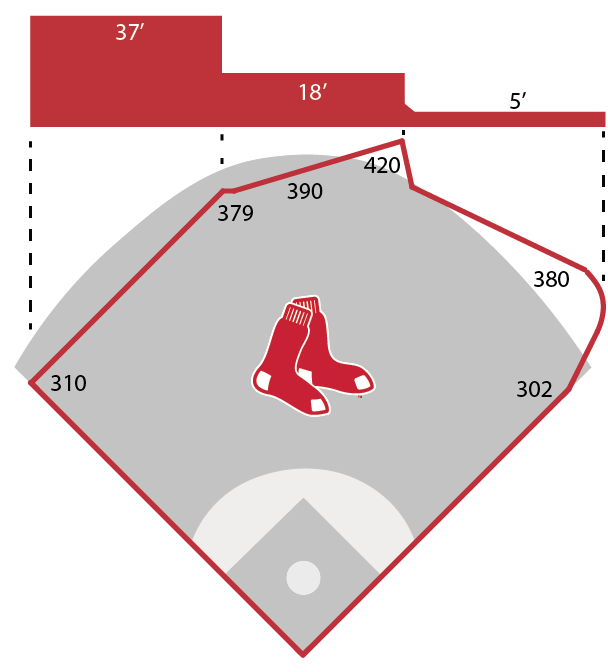
Each component of Fenway's outfield perimeter is unlike any other major league park. Its main focal point of course is the iconic Green Monster which stretches all the way across left field. Measuring a full 37 feet high, the tall fence effectively offsets the extremely short distance from home plate. In fact, left field plays close to neutral for home runs despite measuring just 310 to the left field pole. The types of home runs that make it out of the yard in left, however, often differ from what is typical at other parks. While glorified pop ups can sometimes make it over the LF fence at Fenway, the Green Monster can turn would-be homers in other parks into doubles and even singles off the wall.
Fenway Park measures just 390 to straight-away center, which is closer to home plate than any active MLB venue (Oracle Park is 1 foot farther). But the 18-foot fence makes CF a relatively difficult home run spot. It's undoubtedly more difficult to hit a HR to right-center where the fence angles out toward what's famously known as The Triangle, measuring 420 to its deepest point.
Although one of the more difficult venues for HRs, Fenway is notorious for adding runs to the scoreboard. It's one of the best parks for hits in the yard as the tall fences in left and open spaces in right often reward what are often outs in other parks. Overall, Ballpark Pal rates the venue 23rd for HRs, 3rd for singles, 2nd for doubles and triples, and 3rd for runs.
Fenway Park isn't just interesting for its dimensions as external factors tend to play a major role. Average wind speed is 7.5 mph, but it can be highly variable with a good portion of games played in double-digit wind speeds. When the wind is blowing, it tends to have a major impact on how the ball carries. Ballpark Pal rates Fenway 2nd most receptive to wind overall and 1st in receptiveness to out-blowing winds. The wind blows out 52% of the time compared to 24% blowing in. Combining directional frequencies, winds come from the right side roughly 31% of the time versus 21% from the left.
Temperature in Boston can also be highly variable. While the average start-time temperature is 69.8 degrees, approximately 46% of games are played either above 80 or below 60 degrees. Overall, Ballpark Pal rates Fenway Park 3rd in day-to-day park variation, placing it among the most environmentally volatile venues in MLB.
Each component of Fenway's outfield perimeter is unlike any other major league park. Its main focal point of course is the iconic Green Monster which stretches all the way across left field. Measuring a full 37 feet high, the tall fence effectively offsets the extremely short distance from home plate. In fact, left field plays close to neutral for home runs despite measuring just 310 to the left field pole. The types of home runs that make it out of the yard in left, however, often differ from what is typical at other parks. While glorified pop ups can sometimes make it over the LF fence at Fenway, the Green Monster can turn would-be homers in other parks into doubles and even singles off the wall.
Fenway Park measures just 390 to straight-away center, which is closer to home plate than any active MLB venue (Oracle Park is 1 foot farther). But the 18-foot fence makes CF a relatively difficult home run spot. It's undoubtedly more difficult to hit a HR to right-center where the fence angles out toward what's famously known as The Triangle, measuring 420 to its deepest point.
Although one of the more difficult venues for HRs, Fenway is notorious for adding runs to the scoreboard. It's one of the best parks for hits in the yard as the tall fences in left and open spaces in right often reward what are often outs in other parks. Overall, Ballpark Pal rates the venue 23rd for HRs, 3rd for singles, 2nd for doubles and triples, and 3rd for runs.
Fenway Park isn't just interesting for its dimensions as external factors tend to play a major role. Average wind speed is 7.5 mph, but it can be highly variable with a good portion of games played in double-digit wind speeds. When the wind is blowing, it tends to have a major impact on how the ball carries. Ballpark Pal rates Fenway 2nd most receptive to wind overall and 1st in receptiveness to out-blowing winds. The wind blows out 52% of the time compared to 24% blowing in. Combining directional frequencies, winds come from the right side roughly 31% of the time versus 21% from the left.
Temperature in Boston can also be highly variable. While the average start-time temperature is 69.8 degrees, approximately 46% of games are played either above 80 or below 60 degrees. Overall, Ballpark Pal rates Fenway Park 3rd in day-to-day park variation, placing it among the most environmentally volatile venues in MLB.