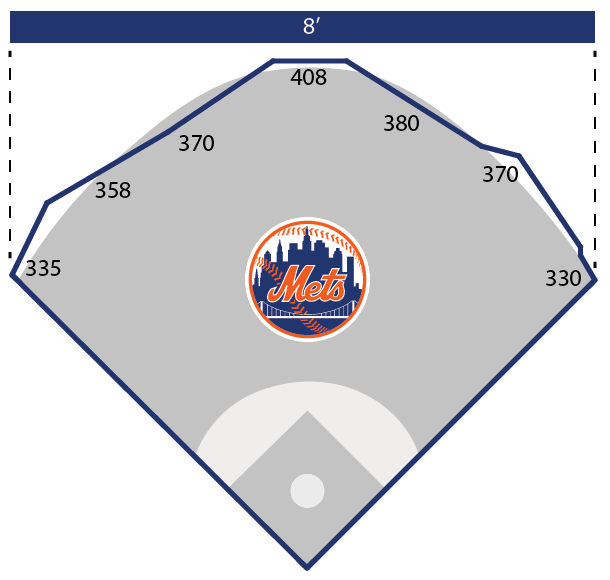
Citi Field was a pure pitchers park when it hosted its first Mets game in 2009, as it rivaled Oracle Park, Kauffman Stadium, and Comerica Park for the most square feet of fair territory. But the Mets front office almost immediately had second thoughts. Just two years later, the deep fences were moved in significantly, and then again in 2015 to where they stand today. While the Queens venue still maintains one of the deepest fences to straight away center (408 feet), it now ranks 21st in MLB for home runs.
The result of all the fence tweaking has created a unique shape to say the least. Perhaps more than any other venue, the outcome of a Citi Field fly ball is highly dependent on the precise line it takes from home plate. Technically, the CF fence is among the deeper ones in the league, but it sharply narrows in on both sides making the power alleys decent home run targets. However, the shape of the outfield is not receptive to extra base hits as Citi Field ranks 29th in MLB for doubles and triples, and it also sits just 24th for singles.
Where Citi Field truly separates itself is in contact suppression. The park grades Poor in contact rate (29th in MLB) and even worse in contact quality, grading Poor and ranking 30th in MLB. Hitters not only put fewer balls in play here — when they do connect, the quality of that contact is among the weakest in the league. That combination is a major reason Ballpark Pal rates Citi Field 28th in MLB for runs at -9% compared to league average.
Even when the ball is hit in the air, it doesn't travel particularly far. Citi Field's typical carry sits at -1% versus league average, ranking 18th overall and reinforcing its generally pitcher-leaning environment.
As much as it varies from corner to corner dimensionally, Citi Field is fairly stubborn when it comes to wind. Despite an average wind speed of 9.6 mph, the park ranks 28th in overall wind receptiveness. The wind blows out 55% of the time and in 22% of games, but the tall bleachers and large scoreboards in center field help neutralize much of its potential impact.
Where Citi Field does show meaningful variability is temperature. The average start-time temperature is 73.4 degrees, with 12% of games played in the 50s and 29% in the 80s. Those seasonal swings contribute to Citi Field ranking 7th in MLB for day-to-day park variation, placing it in the upper tier of environmental volatility among fully outdoor stadiums.
The result of all the fence tweaking has created a unique shape to say the least. Perhaps more than any other venue, the outcome of a Citi Field fly ball is highly dependent on the precise line it takes from home plate. Technically, the CF fence is among the deeper ones in the league, but it sharply narrows in on both sides making the power alleys decent home run targets. However, the shape of the outfield is not receptive to extra base hits as Citi Field ranks 29th in MLB for doubles and triples, and it also sits just 24th for singles.
Where Citi Field truly separates itself is in contact suppression. The park grades Poor in contact rate (29th in MLB) and even worse in contact quality, grading Poor and ranking 30th in MLB. Hitters not only put fewer balls in play here — when they do connect, the quality of that contact is among the weakest in the league. That combination is a major reason Ballpark Pal rates Citi Field 28th in MLB for runs at -9% compared to league average.
Even when the ball is hit in the air, it doesn't travel particularly far. Citi Field's typical carry sits at -1% versus league average, ranking 18th overall and reinforcing its generally pitcher-leaning environment.
As much as it varies from corner to corner dimensionally, Citi Field is fairly stubborn when it comes to wind. Despite an average wind speed of 9.6 mph, the park ranks 28th in overall wind receptiveness. The wind blows out 55% of the time and in 22% of games, but the tall bleachers and large scoreboards in center field help neutralize much of its potential impact.
Where Citi Field does show meaningful variability is temperature. The average start-time temperature is 73.4 degrees, with 12% of games played in the 50s and 29% in the 80s. Those seasonal swings contribute to Citi Field ranking 7th in MLB for day-to-day park variation, placing it in the upper tier of environmental volatility among fully outdoor stadiums.