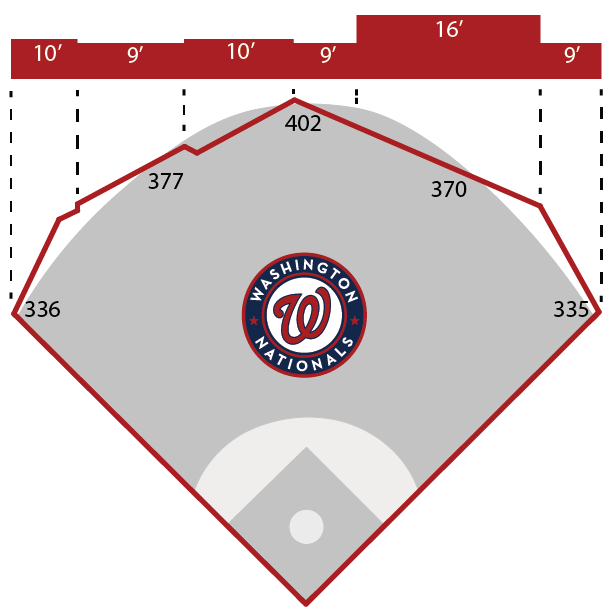
After more than three decades, baseball returned to Washington D.C. in 2005. The former Montreal Expos made their D.C. debut at RFK Stadium, the same venue occupied by the Senators from 1962-71. Opening in 2008, the brand new Nationals Park gave a subtle nod to nearby RFK as the outfield wall's five "corners" perfectly match the on-field measurements of its predecessor at those points.
At a glance, the park's shape resembles Progressive Field and Oriole Park. Nat Park plays further than average down the lines and the fence extends vertically from each foul pole before making a notably left-to-right path through the outfield. The wall is taller than average at all points and measures 16 feet high across most of right field. Undoubtedly, the best spot to hit a home run at Nationals Park is left-center where the fence is shallower than the MLB average and not as tall as it is in right.
In terms of run environment, Nationals Park leans hitter-friendly overall. It ranks 7th in MLB for runs, 11th for home runs, 9th for extra base hits, and 7th for singles, placing it comfortably in the upper third of offensive venues. A major driver of that production is how well the park supports balls in play. Nationals Park ranks 6th in MLB for overall contact and grades Above Average in contact rate, meaning hitters are more likely to put the ball in play here than at most venues. That steady stream of contact helps sustain singles and extra-base production rather than relying strictly on the long ball.
External factors provide moderate variability rather than extreme swings. The park ranks 16th in day-to-day variation, placing it in the middle tier for outdoor stadiums. Wind averages 6.6 mph (27th in MLB), and while it is not especially strong, the venue ranks 11th in overall wind receptiveness, meaning direction can still matter. The wind blows out 44% of the time compared to 27% blowing in, with the remainder largely sideways.
Temperature is a more consistent contributor to offense. Nationals Park averages 78 degrees (9th warmest in MLB), and warm summer conditions frequently support strong carry. Combined with a balanced but slightly hitter-leaning layout and strong contact profile, the Washington venue generally plays lively without reaching the volatility seen in the league's most extreme parks.
At a glance, the park's shape resembles Progressive Field and Oriole Park. Nat Park plays further than average down the lines and the fence extends vertically from each foul pole before making a notably left-to-right path through the outfield. The wall is taller than average at all points and measures 16 feet high across most of right field. Undoubtedly, the best spot to hit a home run at Nationals Park is left-center where the fence is shallower than the MLB average and not as tall as it is in right.
In terms of run environment, Nationals Park leans hitter-friendly overall. It ranks 7th in MLB for runs, 11th for home runs, 9th for extra base hits, and 7th for singles, placing it comfortably in the upper third of offensive venues. A major driver of that production is how well the park supports balls in play. Nationals Park ranks 6th in MLB for overall contact and grades Above Average in contact rate, meaning hitters are more likely to put the ball in play here than at most venues. That steady stream of contact helps sustain singles and extra-base production rather than relying strictly on the long ball.
External factors provide moderate variability rather than extreme swings. The park ranks 16th in day-to-day variation, placing it in the middle tier for outdoor stadiums. Wind averages 6.6 mph (27th in MLB), and while it is not especially strong, the venue ranks 11th in overall wind receptiveness, meaning direction can still matter. The wind blows out 44% of the time compared to 27% blowing in, with the remainder largely sideways.
Temperature is a more consistent contributor to offense. Nationals Park averages 78 degrees (9th warmest in MLB), and warm summer conditions frequently support strong carry. Combined with a balanced but slightly hitter-leaning layout and strong contact profile, the Washington venue generally plays lively without reaching the volatility seen in the league's most extreme parks.