
The Braves only occupied Turner Field for 16 seasons before seeking a new venue. The decision to leave Atlanta for the northern suburbs of Cobb County was criticized for a variety of reasons. Setting aside any ugly aspects of the move, the Braves certainly ended up with a more interesting field to play on, which hosted its first game in 2017.
At face value, Truist Park might appear a bit conventional, but there is nuance that makes it intriguing. Atlanta sits 1,050 feet above sea level (3rd highest in MLB) and the average start-time temperature is 82 degrees (2nd warmest in MLB). Roughly 40% of games are played in 80 degrees and above, and the combination of elevation and heat helps produce above-average carry, where the park ranks 4th in MLB in typical carry distance.
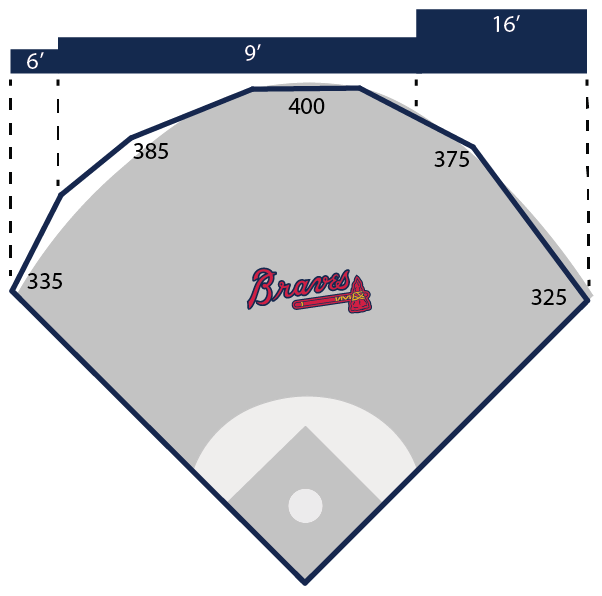
Like its two predecessors, Truist Park's dimensions are designed to prevent cheap home runs, but instead of simply pushing fences back, the designers varied wall heights to create asymmetry. Truist can be described as a less extreme version of PNC Park, separated into three distinct components. The fence in left is deeper than league average but only 6 feet tall down the line. Right field is relatively shallow but protected by a 16-foot wall that suppresses what would otherwise be an inviting home run target. The best spot for a homer is center field, where the fence drops to 9 feet and plays slightly shorter than average.
Despite strong carry conditions, overall production is muted. Truist Park ranks 26th in MLB for runs, 22nd for home runs, and 15th for singles, placing it in the bottom third of overall offensive environments. The elevation and warmth help the ball travel, but the structural dimensions counteract much of that advantage.
Wind is not a dominant factor. Average wind speed is 7.1 mph (24th in MLB) and while it blows out 39% of the time compared to 38% blowing in, the park ranks 19th in overall wind receptiveness, meaning forecasted wind rarely creates dramatic swings in carry.
Overall, Truist Park ranks 18th in day-to-day park variation, reflecting moderate environmental fluctuation but not enough to dramatically alter its identity. The result is a park where the ball can travel, yet run scoring remains consistently below league average due to its carefully engineered dimensions.
At face value, Truist Park might appear a bit conventional, but there is nuance that makes it intriguing. Atlanta sits 1,050 feet above sea level (3rd highest in MLB) and the average start-time temperature is 82 degrees (2nd warmest in MLB). Roughly 40% of games are played in 80 degrees and above, and the combination of elevation and heat helps produce above-average carry, where the park ranks 4th in MLB in typical carry distance.
Like its two predecessors, Truist Park's dimensions are designed to prevent cheap home runs, but instead of simply pushing fences back, the designers varied wall heights to create asymmetry. Truist can be described as a less extreme version of PNC Park, separated into three distinct components. The fence in left is deeper than league average but only 6 feet tall down the line. Right field is relatively shallow but protected by a 16-foot wall that suppresses what would otherwise be an inviting home run target. The best spot for a homer is center field, where the fence drops to 9 feet and plays slightly shorter than average.
Despite strong carry conditions, overall production is muted. Truist Park ranks 26th in MLB for runs, 22nd for home runs, and 15th for singles, placing it in the bottom third of overall offensive environments. The elevation and warmth help the ball travel, but the structural dimensions counteract much of that advantage.
Wind is not a dominant factor. Average wind speed is 7.1 mph (24th in MLB) and while it blows out 39% of the time compared to 38% blowing in, the park ranks 19th in overall wind receptiveness, meaning forecasted wind rarely creates dramatic swings in carry.
Overall, Truist Park ranks 18th in day-to-day park variation, reflecting moderate environmental fluctuation but not enough to dramatically alter its identity. The result is a park where the ball can travel, yet run scoring remains consistently below league average due to its carefully engineered dimensions.