
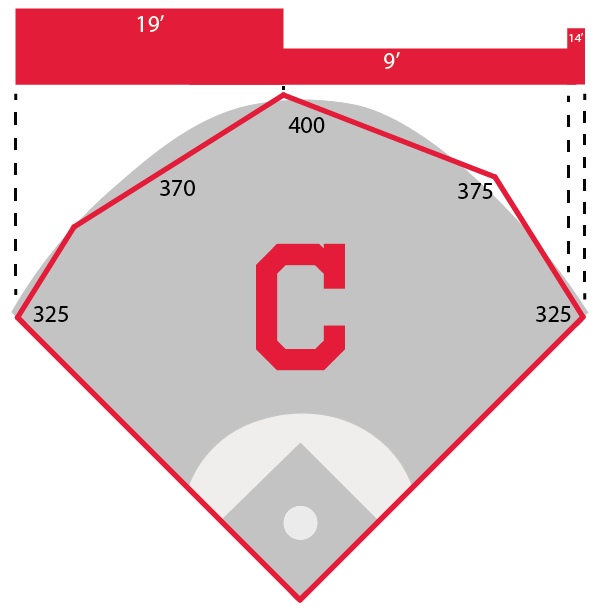
Located within walking distance of Lake Erie, Progressive Field is one of the more structurally balanced parks in Major League Baseball. It has the 3rd smallest outfield in the league (after Citizens Bank Park and Guaranteed Rate Field), but its geometry prevents it from playing as a pure home run haven. Instead, the park is divided into two distinct halves that reward different types of contact.
The left side of the field is defined by its shallow but 19-foot-tall wall in left field. While the shorter distance invites pulled fly balls, the extra height frequently turns what would be routine homers elsewhere into loud doubles off the wall. The ball comes off that surface quickly, often holding hitters to two bases unless it is struck with authority. In contrast, right field features a much shorter 9-foot fence and a more reachable trajectory for left-handed power hitters. Fly balls that might die on the warning track in larger parks have a better chance to clear the wall, especially when atmospheric conditions are favorable.
The power alleys play relatively true, without the dramatic jutting angles seen in more extreme parks. This allows Progressive Field to reward line drives into the gaps while still keeping the outfield compact enough to suppress excessive triples. Its smaller footprint limits how much ground outfielders must cover, which helps prevent it from becoming overly generous for in-play hits despite the inviting wall structure.
Environmental factors add another layer of intrigue. Ballpark Pal ranks Progressive 5th in MLB for park variation. The wind influence is fairly average in magnitude, but direction is inconsistent. It blows in (43%) of the time compared to 32% blowing out, meaning pitchers often receive a subtle advantage from air resistance rather than a boost toward the fences. When the wind does blow out, however, the compact dimensions allow the effect to show up quickly on deep fly balls.
Temperature is the primary driver of Cleveland's variability. 36% of games are played in temperatures either below 60 degrees or above 80 degrees. Cold April and September nights can noticeably suppress carry, while warm midsummer games allow the ball to jump more than the park's raw dimensions might suggest. This temperature swing, paired with inconsistent wind direction, is what elevates Progressive Field into the Top 5 for day-to-day environmental volatility.
Overall, Progressive Field avoids extremes. It does not lean overwhelmingly toward pitchers or hitters, but instead rewards well-struck contact of multiple varieties. The architectural balance between wall height, fence distance, and compact fair territory gives it a versatile offensive profile that can shift meaningfully based on the weather.
The left side of the field is defined by its shallow but 19-foot-tall wall in left field. While the shorter distance invites pulled fly balls, the extra height frequently turns what would be routine homers elsewhere into loud doubles off the wall. The ball comes off that surface quickly, often holding hitters to two bases unless it is struck with authority. In contrast, right field features a much shorter 9-foot fence and a more reachable trajectory for left-handed power hitters. Fly balls that might die on the warning track in larger parks have a better chance to clear the wall, especially when atmospheric conditions are favorable.
The power alleys play relatively true, without the dramatic jutting angles seen in more extreme parks. This allows Progressive Field to reward line drives into the gaps while still keeping the outfield compact enough to suppress excessive triples. Its smaller footprint limits how much ground outfielders must cover, which helps prevent it from becoming overly generous for in-play hits despite the inviting wall structure.
Environmental factors add another layer of intrigue. Ballpark Pal ranks Progressive 5th in MLB for park variation. The wind influence is fairly average in magnitude, but direction is inconsistent. It blows in (43%) of the time compared to 32% blowing out, meaning pitchers often receive a subtle advantage from air resistance rather than a boost toward the fences. When the wind does blow out, however, the compact dimensions allow the effect to show up quickly on deep fly balls.
Temperature is the primary driver of Cleveland's variability. 36% of games are played in temperatures either below 60 degrees or above 80 degrees. Cold April and September nights can noticeably suppress carry, while warm midsummer games allow the ball to jump more than the park's raw dimensions might suggest. This temperature swing, paired with inconsistent wind direction, is what elevates Progressive Field into the Top 5 for day-to-day environmental volatility.
Overall, Progressive Field avoids extremes. It does not lean overwhelmingly toward pitchers or hitters, but instead rewards well-struck contact of multiple varieties. The architectural balance between wall height, fence distance, and compact fair territory gives it a versatile offensive profile that can shift meaningfully based on the weather.