
Globe Life Field opened in 2020 as the retractable-roof successor to Globe Life Park, bringing climate control to Arlington while maintaining many of the franchise's traditional design principles. The exterior blends brick and glass in a modern interpretation of the Rangers' prior home, but the most defining feature is the full enclosure that dramatically reduces environmental volatility compared to its predecessor.
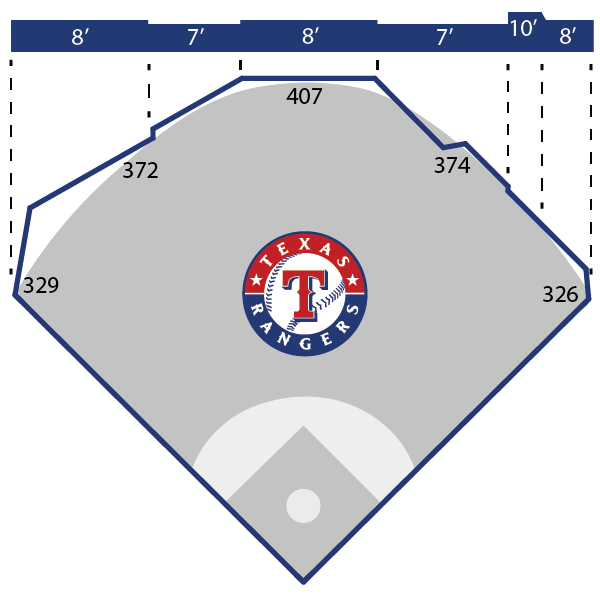
On the field, Globe Life Field plays slightly pitcher-friendly overall, ranking 25th in MLB for runs, 20th for home runs, 23rd for doubles and triples, and 19th for singles. While not extreme in any one category, the park leans modestly toward suppressing offense across the board. The outfield itself ranks 12th in size, sitting near the middle of the league, and its dimensions are fairly balanced from line to line. There is no exaggerated short porch or massive alley that drastically skews results in one direction, which contributes to its steady, controlled run environment.
One of the more subtle traits of Globe Life Field is contact quality. While overall contact rate ranks 18th, contact quality grades much more favorably at 4th in MLB, suggesting that when hitters do square the ball up, it tends to be struck well. That quality, however, is partially offset by environmental conditions that slightly reduce carry. Typical fly balls travel 1.18% shorter than league average, ranking 17th in carry distance.
Environmental factors are largely muted due to the roof. The retractable structure is closed approximately 83% of the time and open only 17%, dramatically limiting wind influence and temperature swings. Even when open, average wind speed is 9.0 mph (12th in MLB), with winds blowing in 34% of games and out 31%, producing relatively balanced directional tendencies. Overall wind receptiveness ranks 17th, placing it squarely in the middle tier.
Temperature averages 80.8 degrees, and Arlington's 616-foot altitude (8th highest in MLB) provides a modest elevation boost compared to most venues. Even so, the controlled roof usage keeps Globe Life Field from becoming volatile. The stadium ranks 28th in park variation, placing it among the least variable environments in Major League Baseball outside of fully enclosed domes.
In short, Globe Life Field is defined less by quirky geometry or extreme weather effects and more by consistency. It does not dramatically inflate or suppress any single offensive category, but its controlled climate and moderate carry reduction combine to create a stable, slightly pitcher-leaning run environment that changes little from day to day.
On the field, Globe Life Field plays slightly pitcher-friendly overall, ranking 25th in MLB for runs, 20th for home runs, 23rd for doubles and triples, and 19th for singles. While not extreme in any one category, the park leans modestly toward suppressing offense across the board. The outfield itself ranks 12th in size, sitting near the middle of the league, and its dimensions are fairly balanced from line to line. There is no exaggerated short porch or massive alley that drastically skews results in one direction, which contributes to its steady, controlled run environment.
One of the more subtle traits of Globe Life Field is contact quality. While overall contact rate ranks 18th, contact quality grades much more favorably at 4th in MLB, suggesting that when hitters do square the ball up, it tends to be struck well. That quality, however, is partially offset by environmental conditions that slightly reduce carry. Typical fly balls travel 1.18% shorter than league average, ranking 17th in carry distance.
Environmental factors are largely muted due to the roof. The retractable structure is closed approximately 83% of the time and open only 17%, dramatically limiting wind influence and temperature swings. Even when open, average wind speed is 9.0 mph (12th in MLB), with winds blowing in 34% of games and out 31%, producing relatively balanced directional tendencies. Overall wind receptiveness ranks 17th, placing it squarely in the middle tier.
Temperature averages 80.8 degrees, and Arlington's 616-foot altitude (8th highest in MLB) provides a modest elevation boost compared to most venues. Even so, the controlled roof usage keeps Globe Life Field from becoming volatile. The stadium ranks 28th in park variation, placing it among the least variable environments in Major League Baseball outside of fully enclosed domes.
In short, Globe Life Field is defined less by quirky geometry or extreme weather effects and more by consistency. It does not dramatically inflate or suppress any single offensive category, but its controlled climate and moderate carry reduction combine to create a stable, slightly pitcher-leaning run environment that changes little from day to day.