In July 1999 the Mariners traded in the fully enclosed Kingdome for the never enclosed Safeco Field. Yes, the now T-Mobile Park does have a retractable roof, but unlike any other in MLB it serves as an umbrella for the field rather than a total enclosure. The roof's main purpose is to prevent rain-outs and it only takes about 10 minutes to protect the playing surface from the showers that so frequently occur in Seattle. Although it's sometimes used to keep the stadium warm on particularly cold nights, it's left open even on the hottest days.
While the unique roof gets a lot of attention, it isn't used very often as 86% of games are played with it left open. Perhaps the most defining feature of T-Mobile Park is the short distance that fly balls tend to carry. According to the Ballpark Pal distance model, balls hit more than 300 feet typically carry about 2.15% less than the MLB average (27th in MLB), attributed partly to the sea-level altitude and below average temperatures in Seattle.
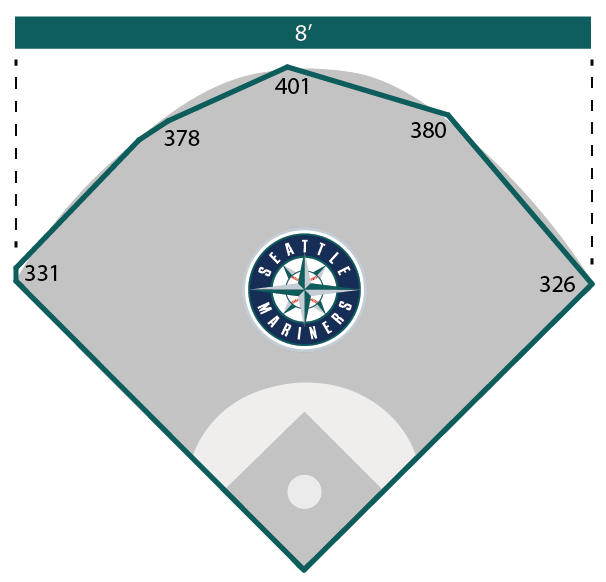
It seems the stadium architects anticipated relatively short carry distances, though the field itself ranks 25th in outfield size, placing it closer to the larger end of the spectrum rather than among the smallest parks. It's most comparable in overall shape to Great American Ball Park in Cincinnati, with subtle perimeter angles that influence ball flight outcomes.
But the real identity of T-Mobile Park shows up in the batter-pitcher interaction. It is the #1 strikeout environment in MLB, and overall batter contact grades Poor (27th). Contact quality grades Bad (23rd), meaning that even when hitters do put the ball in play, it is less likely to turn into damaging contact. That contact suppression pairs with the shorter carry to create an extremely run-suppressing venue, even though home runs themselves are closer to neutral (14th). Overall, the park ranks 29th for singles, 30th for doubles and triples, and 30th for total runs, firmly placing it among the lowest run-producing environments in MLB. One possible contributor is visual comfort, as a quirky, angled batter's eye can subtly change how hitters pick up spin and depth, which can snowball into more swing-and-miss and weaker contact.
The wind blows left-to-right 26% of the time at T-Mobile Park (compared to just 2% right-to-left), with winds blowing out 40% of games and in 32%. Average wind speed is 5.2 mph, and the park ranks 7th in overall wind receptiveness, meaning directional shifts can meaningfully influence carry even if baseline speeds are modest.
While the unique roof gets a lot of attention, it isn't used very often as 86% of games are played with it left open. Perhaps the most defining feature of T-Mobile Park is the short distance that fly balls tend to carry. According to the Ballpark Pal distance model, balls hit more than 300 feet typically carry about 2.15% less than the MLB average (27th in MLB), attributed partly to the sea-level altitude and below average temperatures in Seattle.
It seems the stadium architects anticipated relatively short carry distances, though the field itself ranks 25th in outfield size, placing it closer to the larger end of the spectrum rather than among the smallest parks. It's most comparable in overall shape to Great American Ball Park in Cincinnati, with subtle perimeter angles that influence ball flight outcomes.
But the real identity of T-Mobile Park shows up in the batter-pitcher interaction. It is the #1 strikeout environment in MLB, and overall batter contact grades Poor (27th). Contact quality grades Bad (23rd), meaning that even when hitters do put the ball in play, it is less likely to turn into damaging contact. That contact suppression pairs with the shorter carry to create an extremely run-suppressing venue, even though home runs themselves are closer to neutral (14th). Overall, the park ranks 29th for singles, 30th for doubles and triples, and 30th for total runs, firmly placing it among the lowest run-producing environments in MLB. One possible contributor is visual comfort, as a quirky, angled batter's eye can subtly change how hitters pick up spin and depth, which can snowball into more swing-and-miss and weaker contact.
The wind blows left-to-right 26% of the time at T-Mobile Park (compared to just 2% right-to-left), with winds blowing out 40% of games and in 32%. Average wind speed is 5.2 mph, and the park ranks 7th in overall wind receptiveness, meaning directional shifts can meaningfully influence carry even if baseline speeds are modest.