
It's not often that a baseball team replaces a fully enclosed dome with an outdoor stadium, but that's what the Twins did in 2010. Many were skeptical of the decision to not include a retractable roof at the new venue as 40-degree days in April and September are all too common in Minneapolis. But the low temperatures are not as extreme as some may have anticipated as only about 7% of games at Target Field are played below 50 degrees throughout the season.
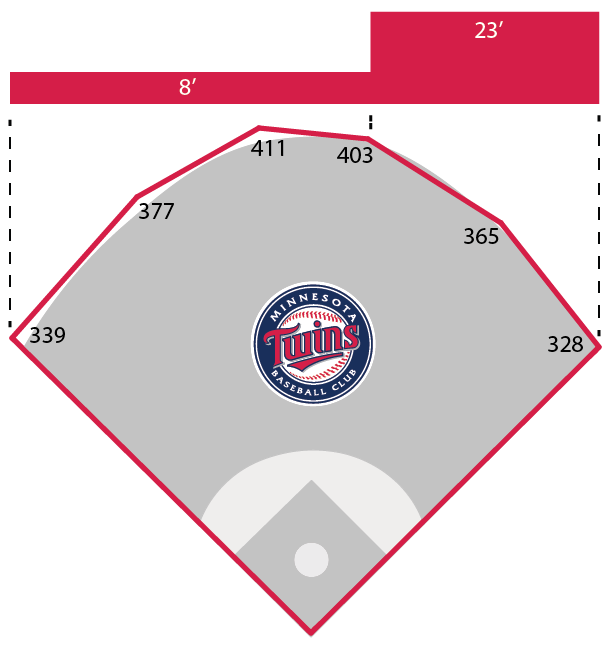
As much as Target Field is different than the Metrodome, the new field included a few prominent design characteristics that paid homage to its predecessor. Most notable is the 23-foot wall that extends across the entire right side of the field, which matches both the height and placement of 'the baggy' at the old dome. There's even a section of bleachers on that side uniquely hanging over the warning track that was designed to emulate its former.
Target Field can be solidly characterized as a pitchers park, though not among the most extreme. While the left side measures further than average at all points, the right side's shallower dimensions are protected by the aforementioned wall measuring 23 feet in height. While the tall RF fence can be a good target for doubles and triples, every part along the outfield perimeter is at least a moderately difficult home run spot. Ballpark Pal ranks Target Field 24th for home runs and 11th for doubles and triples, highlighting how its spacious gaps create extra-base opportunities even as it suppresses long balls.
An interesting tidbit about Target Field is that its 8.5 acre footprint is the smallest in MLB. As a result of the small plot of land it sits on, the stadium architects were forced to creatively stack and angle the bleachers vertically, which creates somewhat of a bowl shape. This likely makes fly balls less receptive to wind as Ballpark Pal rates it 21st in overall wind receptiveness, despite average wind speeds around 9 mph and winds blowing out 39% of the time compared to 35% blowing in.
The venue does vary throughout the season, though less than previously suggested, ranking 17th in park variation. This has a lot to do with the fluctuating temperature in Minneapolis. About 18% of games are played below 60 degrees, while roughly 34% are played above 80, meaning approximately 51% of games occur in more extreme temperature bands.
As much as Target Field is different than the Metrodome, the new field included a few prominent design characteristics that paid homage to its predecessor. Most notable is the 23-foot wall that extends across the entire right side of the field, which matches both the height and placement of 'the baggy' at the old dome. There's even a section of bleachers on that side uniquely hanging over the warning track that was designed to emulate its former.
Target Field can be solidly characterized as a pitchers park, though not among the most extreme. While the left side measures further than average at all points, the right side's shallower dimensions are protected by the aforementioned wall measuring 23 feet in height. While the tall RF fence can be a good target for doubles and triples, every part along the outfield perimeter is at least a moderately difficult home run spot. Ballpark Pal ranks Target Field 24th for home runs and 11th for doubles and triples, highlighting how its spacious gaps create extra-base opportunities even as it suppresses long balls.
An interesting tidbit about Target Field is that its 8.5 acre footprint is the smallest in MLB. As a result of the small plot of land it sits on, the stadium architects were forced to creatively stack and angle the bleachers vertically, which creates somewhat of a bowl shape. This likely makes fly balls less receptive to wind as Ballpark Pal rates it 21st in overall wind receptiveness, despite average wind speeds around 9 mph and winds blowing out 39% of the time compared to 35% blowing in.
The venue does vary throughout the season, though less than previously suggested, ranking 17th in park variation. This has a lot to do with the fluctuating temperature in Minneapolis. About 18% of games are played below 60 degrees, while roughly 34% are played above 80, meaning approximately 51% of games occur in more extreme temperature bands.