Park Factors

Last Updated: 1:30 AM
There's a wide variety of hitting conditions on Sunday afternoon with temperatures ranging from low 60s to over 100°. The latter of which is in Sacramento where Sutter Health Park is rated the slate's top venue for home runs. Despite the heat, SHP isn't playing quite as well this afternoon as it has during the summer with low humidity levels and the usual out-blowing wind only at single-digit speeds.
It's going to be above 90° in L.A. for Dbacks / Dodgers this afternoon. Although it's hardly ever cold, only 5% of Dodgers home games are played in temps above 90°. As usual, there will be a light breeze blowing out toward right-center.
Some of the most impactful wind on Sunday is in Cleveland where it will blow in from right-center at 10-15 mph. Progressive Field is receptive to wind, and the pitcher-friendly gusts are paired with cooler temps and high air pressure this afternoon.
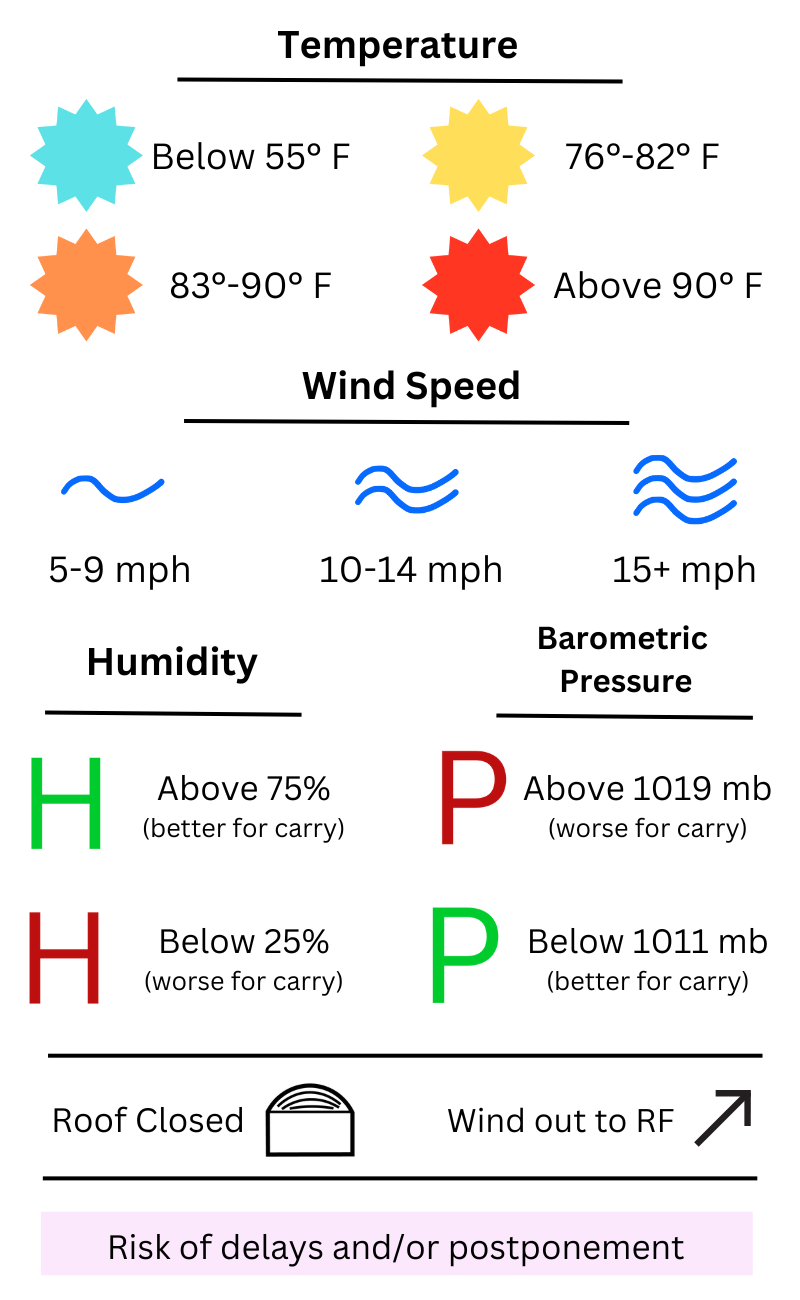
Air pressure is a theme for Sunday with most venues expecting levels on the highest end of the spectrum. Like cold weather, high pressure is a factor that reduces how far the ball flies. This is indicated by the red "P"s in the chart below.
Outside of the usual 60° at Oracle Park, the coolest temperatures on the slate are in Kansas City where it will be extra difficult to carry the deep outfield fence today. It will be in the 60s at Kauffman Stadium with light wind blowing in from right along with a decent chance of rain.
| Game | HR | 2B/3B | 1B | Runs | Receptive | Hour 1 | Hour 2 | Hour 3 | Hour 1 | Hour 2 | Hour 3 | Humidity | Pressure | Outfield Size |
Altitude | Typical Flight |
Contact Rate |
Contact Quality |
Description | HR | 2B/3B | 1B | Runs | |||||
|---|---|---|---|---|---|---|---|---|---|---|---|---|---|---|---|---|---|---|---|---|---|---|---|---|---|---|---|---|
Coors Field 3:10 | +18% | +38% | +11% | +32% | Low | 6  | 6 | 6 | 81° | 82° | 82° | 32% | 1020 | X-Large | 5,183 | +29 | Great | Avg | An extreme outlier of a stadium. Played 4,000 feet higher in altitude than the next closest MLB park. Has an extra-large outfield to accommodate much farther carry distances. Excellent for batter contact as the high altitude limits pitch effectiveness. | +0.41 | +1.34 | +1.13 | +2.83 | |||||
Sutter Health Park 4:05 | +18% | +7% | +6% | +15% | Very High | 6  | 7 | 10  | 106° | 108° | 106° | 11% | 1012 | Large | 30 | Good | Avg | The temporary home of the Athletics. Features a spacious outfield with a tiny right-field fence. Standard to the corners and center, bowed outward in the gaps. | +0.41 | +0.26 | +0.64 | +1.28 | ||||||
Fenway Park 1:35 | -17% | +21% | +12% | +11% | High | 8  | 9  | 9 | 70° | 70° | 70° | 46% | 1022 | Variable | 20 | -3 | Good | Great | A one-of-a-kind shape with a deep right field and a 37-foot-tall fence guarding the extremely shallow left side. Similarly, the 18-foot-tall fence in center offsets the close distance to home plate. While the tall fences help neutralize homers, they are excellent targets for singles and doubles. | -0.39 | +0.72 | +1.30 | +0.93 | |||||
Dodger Stadium 4:10 | +16% | -5% | +1% | +5% | Consistent | 9 | 10 | 11 | 93° | 95° | 95° | 35% | 1012 | Medium | 267 | +3 | Avg | Great | A symmetrical outfield with a highly consistent wind pattern (out to right-center). Plays deep down the lines and particularly shallow to center field. | +0.35 | -0.17 | +0.14 | +0.45 | |||||
Kauffman Stadium 2:10 | -28% | +16% | +10% | +4% | High | 11 | 11 | 11 | 66° | 64° | 70° | 85% | 1022 | X-Large | 750 | +5 | Great | Good | The largest non-Coors outfield in MLB. Perfectly symmetrical with a 9-foot-tall fence rounding the perimeter. | -0.62 | +0.58 | +1.07 | +0.33 | |||||
Great American BP 12:10 | +4% | -4% | +4% | +3% | Low | 7  | 7 | 8 | 75° | 79° | 81° | 46% | 1023 | Small | 683 | +0 | Bad | Avg | The smallest outfield in MLB, offset partially by a taller left-field wall. Stadium architecture dampens the effect from wind but hot days can turn GABP into a home run paradise. | +0.08 | -0.15 | +0.46 | +0.27 | |||||
Nationals Park 1:35 | -10% | +12% | +2% | +3% | Med-High | 5 | 6 | 6 | 75° | 77° | 77° | 36% | 1023 | Medium | 25 | -2 | Great | Great | A horizontal-shaped outfield with taller-than-average fences. Shallow to center field and deep to the corners. A 16-foot wall covers most of the right-field gap, compensating for how close it is at parts. | -0.22 | +0.42 | +0.22 | +0.23 | |||||
Oracle Park 4:05 | -19% | +5% | +11% | +3% | Consistent | 8 | 9 | 9 | 63° | 63° | 64° | 87% | 1014 | Variable | 63 | 0 | Good | Poor | A uniquely shaped field with a 24 foot-tall fence guarding a very shallow right-field corner. Straight-away center is close to home plate but extends to an extremely deep right-field gap. Cool temperatures are the norm and the ever-present out-blowing wind is neutralized by the stadium architecture. | -0.43 | +0.17 | +1.20 | +0.23 | |||||
Citizens Bank Park 7:10 | +16% | -7% | -2% | +2% | Very High | 7  | 6  | 4 | 77° | 75° | 75° | 40% | 1022 | Small | 9 | -3 | Bad | Great | One of the smaller outfields in MLB. Relies on tall fences to keep home runs from getting out of hand. The most wind-receptive venue outside of Wrigley. | +0.36 | -0.25 | -0.22 | +0.15 | |||||
Target Field 1:05 | -15% | +9% | +3% | +0% | Medium | 4 | 5 | 6 | 73° | 75° | 79° | 51% | 1025 | Medium | 812 | +0 | Avg | Good | A slightly asymmetric outfield with a deeper-than-average left side. The more shallow right side is guarded by a 23-foot-tall fence with a unique balcony overhanging the field. | -0.35 | +0.32 | +0.32 | +0.00 | |||||
Rogers Centre 1:37 | -4% | +7% | -4% | -2% | Minimal | 3 | 5 | 6 | 77° | 79° | 79° | 51% | 1025 | Medium | 247 | +0 | Great | Good | A neutral-sized retractable roof venue where every opportunity is taken to play outdoors. A closed roof is well-received by hitters on cold Toronto days but can favor pitchers when its hot out. | -0.09 | +0.25 | -0.45 | -0.17 | |||||
Rate Field 2:10 | -2% | -11% | +2% | -4% | Med-High | 7 | 8 | 9 | 77° | 79° | 77° | 51% | 1025 | Small | 596 | -3 | Bad | Avg | The smallest outfield in MLB. Shallow in every direction. Not nearly as wind-prone as its Wrigley neighbor, but can be susceptible to homers - especially on hot days. | -0.05 | -0.39 | +0.20 | -0.36 | |||||
Progressive Field 1:40 | -22% | +7% | +1% | -5% | High | 9 | 11  | 11 | 70° | 72° | 72° | 57% | 1025 | Small | 582 | -5 | Avg | Poor | A small outfield with two distinct halves. A 19-foot fence guards most of the outfield's left side while the shorter right-field fence leaves that half vulnerable to home runs. | -0.49 | +0.24 | +0.15 | -0.40 | |||||
Daikin Park 2:10 | -2% | -8% | -5% | -8% | Roof Closed | Roof Closed | Variable | 38 | 0 | Bad | Poor | A retractable-roof venue with strict rules for allowing an open roof. A one-of-a-kind shape with a particularly shallow left-field fence. Plays deep to center and short to right. | -0.04 | -0.28 | -0.57 | -0.74 | ||||||||||||
Citi Field 1:40 | -5% | -20% | -3% | -12% | Low | 5 | 6 | 6 | 81° | 82° | 82° | 38% | 1022 | Medium | 54 | -1 | Poor | Poor | An unusually-shaped outfield with deep corners, shallow gaps, and a deep straight-away measurement to center. One of the worst venues for batter contact in the league. | -0.10 | -0.69 | -0.30 | -1.03 | |||||